Key Summary
- Most businesses don’t need more data. They need better ways to use it.
- AI in business consulting is reducing time spent on reporting and analysis.
- AI agents and generative AI are changing how work gets done.
- Strong AI adoption starts with business problems, not technology.
- Enterprise AI solutions are helping teams improve decision-making and efficiency.
In 2026, business leaders are not struggling because they lack information. If anything, they have the opposite problem.
There are reports, dashboards, spreadsheets, custom data, financial data, operational data, and more notifications than anyone knows what to do with. Now, the biggest challenge is figuring out what actually matters and making the right decisions before the opportunity passes.
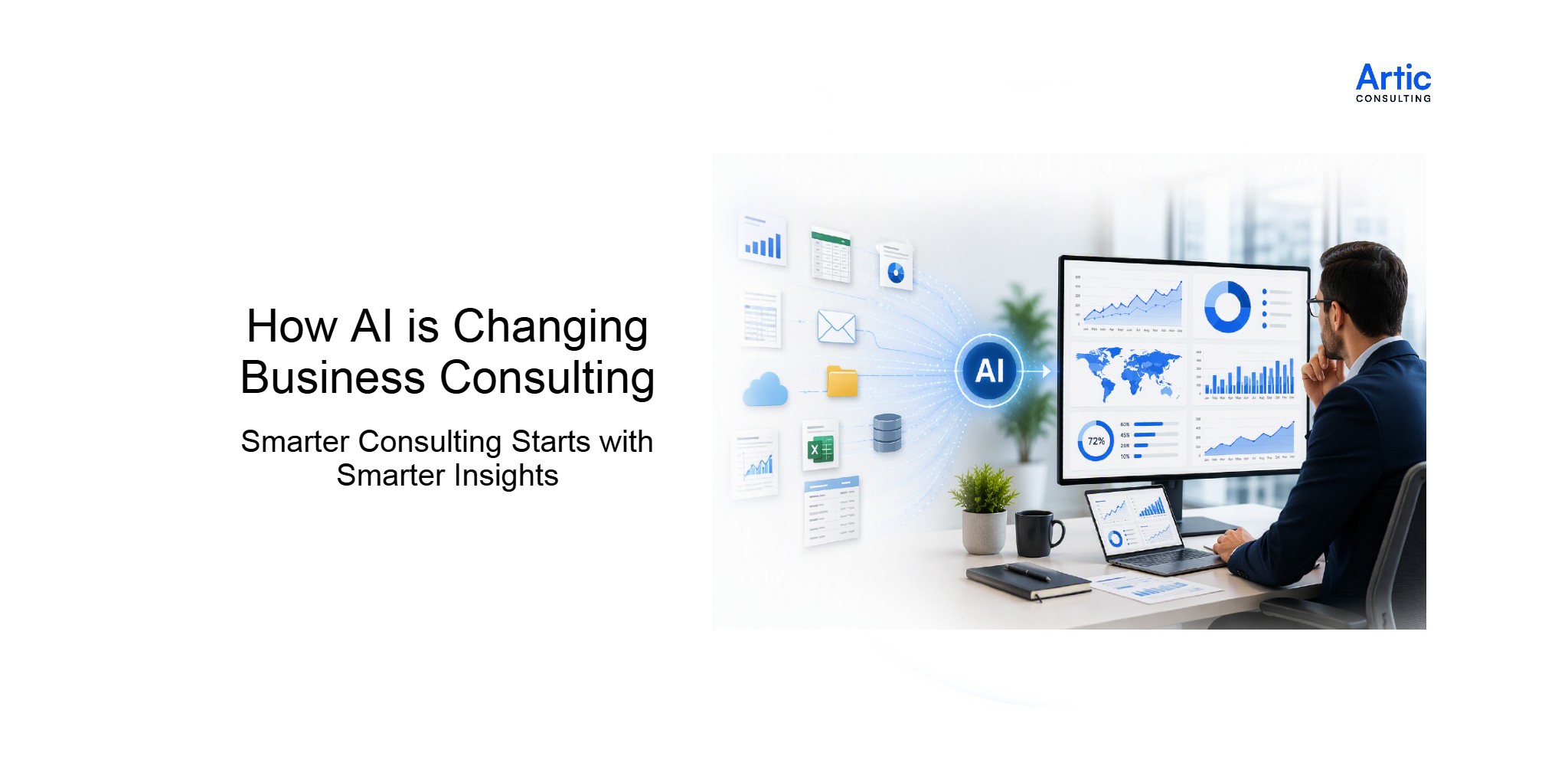
This is one of the major reasons why AI in business consulting has become such a huge deal. Most organizations aren’t starting their AI journey because they suddenly became interested in new technology. They’re starting because too much information is spread across too many places.
Consultants have always spent a lot of time reviewing data, tracking down answers, and trying to connect pieces of information. AI doesn’t remove that work, but it can shorten parts of the process.
Microsoft’s Work Trend Index points to a problem many teams already recognize: people spend a surprising amount of their day searching for information. When that happens at scale, finding answers becomes a business problem rather than just an inconvenience.
That helps explain the increase in AI adoption. Organizations are testing different ways to use AI, whether it’s improving decision-making, supporting operational efficiency, or helping employees navigate growing amounts of information.
How AI is Changing the Consulting Process
Most businesses bring in consultants in two situations. One is when things aren’t going as planned. For instance, something is unclear, numbers don’t add up, or there’s just too much going on to make sense of.
Another instance is things are working perfectly well but they need to improve processes, streamline workflows, etc.
A lot of the work starts with trying to understand the situation. That means looking at reports, talking to people, digging through systems, and slowly putting the picture together. That part is still there, but it doesn’t take the same amount of time anymore, at least not in the same way.
AI is starting to take some of that load. Not everything, but enough to change how the work happens.
Helps Consultants Analyze Business Data Faster
There’s always a lot to go through in a consulting project. Different reports, internal data, feedback from teams, or sometimes even documents that haven’t been touched in a while.
Earlier, just reviewing all of this could take days. It was slow, and honestly, a bit messy. Now, some of that can be handled much quicker.
Reports, meeting notes, operational data, and business documents can be grouped and summarized faster, reducing the time spent on manual analysis.
It doesn’t mean the work disappears. Someone still needs to look at it properly. But the starting point is quicker, which changes where most of the effort goes.
Improves Data Analysis and Business Insights
One thing that hasn’t really changed is how much data businesses already have. In most cases, there’s more than enough. The problem is figuring out what matters inside all of it.
Sometimes patterns are obvious. Most of the time, they aren’t. That’s where AI helps a bit. It can highlight things that might not stand out immediately. A drop somewhere, a strange spike, something that just looks off.
It’s not perfect, and it doesn’t explain everything. But it gives you something to start with instead of staring at everything from scratch.
Enhances Business Forecasting and Strategic Planning
A lot of consulting work eventually comes down to questions about the future. What could happen next? What should be adjusted? Where are the risks?
AI can help by looking at past data and pointing out patterns. That part is useful, especially when the volume is too large to go through manually.
Many organizations are also incorporating AI into their business intelligence and forecasting processes to evaluate risks, opportunities, and potential outcomes more efficiently.
But it’s only one layer. Context still matters. What’s happening in the market, what’s changing inside the company, what leadership is trying to do, none of that comes directly from data alone.
So even if the input is faster, the thinking part doesn’t really get skipped.
Reduces Manual Tasks in Consulting Projects
There’s always been a lot of routine work in consulting. Putting things into slides, summarizing inputs, cleaning up reports, that kind of work quietly takes up a lot of time.
That is where AI is starting to make a difference. McKinsey notes that generative AI has the potential to automate portions of knowledge work across functions including analysis, reporting, and content creation.
Which means you don’t spend as much time assembling everything. Instead, more time goes into discussions. What are we looking at? Does this actually matter? Are we missing something?
It shifts the work slightly, even if the overall goal stays the same.
Why Human Expertise Still Matters in AI Consulting
All of this still leads to the same place. A decision has to be made. AI can help process information, no doubt about that. It can speed things up and sometimes make things clearer.
But it doesn’t decide what’s important. It doesn’t understand trade-offs in the same way a person does. And it doesn’t take responsibility for what happens next.
So the job is still about making sense of things and deciding what to do. That part hasn’t really changed. This is one reason many organizations continue to view AI as a tool for augmentation rather than replacement.
Gartner predicts that organizations combining AI with human oversight will achieve better outcomes than those relying on automation alone.
AI Technologies Consulting Firms Are Helping Businesses Adopt
The conversation around AI has expanded beyond chatbots and content generation at this point. Depending on their goals, organizations are evaluating different AI technologies to improve productivity, automate work, and gain faster access to information.
AI Agents
AI agents can perform tasks across multiple steps with limited human involvement. Instead of simply generating content, they can collect information, analyze data, trigger actions, and support specific business processes. Organizations are beginning to explore AI agents for activities such as research, reporting, customer support, and workflow automation.
Generative AI
Generative AI remains one of the most widely adopted AI technologies. Businesses are using it to summarize documents, draft content, support knowledge management, and help employees find information faster. Tools such as Microsoft Copilot have made generative AI more accessible within everyday business applications and accelerated AI adoption in business environments.
Intelligent Automation
Organizations are increasingly combining AI with automation to reduce repetitive manual work. Tasks such as document processing, data entry, workflow routing, and approval processes can often be completed more efficiently with AI-powered automation.
AI-Powered Analytics and Forecasting
Many businesses are also using AI to analyze large volumes of data, identify trends, and support forecasting efforts. Rather than replacing human decision-making, these tools help teams uncover insights faster and evaluate potential outcomes more efficiently.
These capabilities are becoming an important part of modern AI-powered analytics strategies, helping businesses make more data-driven decisions.
How Artic Consulting Helps Businesses Navigate AI Adoption
A lot of AI conversations start in a practical place. It’s usually not about building an AI strategy for the entire organization or finding ways to use AI everywhere. More often, teams are trying to solve a specific problem that’s slowing work down.
Questions tend to look more like this:
- Can reporting take less time?
- Can employees find information without digging through multiple systems?
- Can some of the repetitive work be automated?
- Can we make better use of the data we already have?
That’s often the point where organizations start exploring AI adoption.
At Artic Consulting, we work with businesses that are modernizing operations, improving reporting, and moving forward with broader digital transformation initiatives. In some cases AI is a major part of the project. In others, it becomes relevant after underlying data, systems, or processes are addressed.
Rather than starting with a specific tool, we spend time understanding how work actually gets done today. Where are teams losing time? Which processes create frustration? What information is difficult to access? Those answers usually shape the technology decisions that follow.
From there, we help organizations evaluate and implement solutions such as Microsoft Copilot, Microsoft Fabric, Power BI, Dynamics 365, Azure AI Services, and Power Platform as part of larger enterprise AI solutions and modernization efforts.
The goal isn’t to introduce AI for the sake of using AI. It’s to help people spend less time searching, gathering, and manually processing information so they can focus on work that requires judgment, experience, and decision-making. That’s where our AI consulting services tend to create the most value.
Ready to Make AI Work for Your Business?
From reporting and analytics to automation and decision-making, we help businesses apply AI where it creates real operational value.
FAQs
Can AI replace business consultants?
Not really. AI can handle parts of the work. It can go through data, highlight patterns, even give a rough analysis. That part is useful. But it doesn’t understand the full business situation. It doesn’t know internal priorities, team dynamics, or what’s realistically possible.
What is the biggest challenge businesses face when adopting AI?
In most cases, it comes back to data. Different systems, different formats, sometimes even different versions of the same data. So even if the AI tool works fine, it doesn’t always have clean or reliable inputs. That’s where things slow down. A lot of companies realize this only after they start, and then end up fixing their data before they can move forward.
Where should a business start with AI?
Most organizations see better results when they start with a specific business problem rather than the technology. It could be improving reporting, reducing manual work, speeding up access to information, or enhancing forecasting. Starting with a clear use case usually makes adoption easier and helps demonstrate value more quickly.
Get started
Ready to level-up your business?

Amit Giri has 14 years of experience helping organizations navigate technology decisions and align solutions with business goals. His interests include artificial intelligence, Microsoft technologies, cloud solutions, data analytics, digital transformation, and process improvement. Through Artic Insights, Amit shares practical perspectives on using technology to solve real-world business challenges and create lasting value.