Key Summary
- Many fraud investigations begin with activity that looks completely normal at first. It’s usually the small details that change the story.
- Most fraud teams don’t need more alerts. They need faster ways to identify which alerts deserve attention through fraud analytics.
- For this BFSI firm, the challenge wasn’t a lack of data. It was having information spread across different systems.
- Artic brought together Azure, Power BI, and AI capabilities to support real-time fraud detection and improve visibility across the business.
- The company reported a 40% reduction in fraudulent transactions through AI-powered fraud detection, while also improving customer satisfaction and day-to-day operations.
Most banks don’t have a data problem. If anything, they have the opposite problem.
There’s transaction data, customer data, login activity, card activity, account activity, and plenty of systems generating alerts throughout the day. The information is there. The hard part is figuring out which signals actually matter.
Fraud teams know this well. Hundreds of alerts can come in, but only a small number end up being genuine threats. Meanwhile, fraud tactics keep changing. What worked a year ago may not catch the same activity today.
In IBM’s Cost of a Data Breach Report, compromised credentials remained one of the most common attack vectors, highlighting why financial institutions continue investing in stronger fraud detection capabilities.
That’s why more financial institutions are investing in AI fraud detection as part of their fraud prevention strategies. Not because traditional systems have stopped working altogether, but because they’re being asked to keep up with a level of volume and complexity they weren’t originally built for.
The conversation around fraud detection in banking has also evolved. Instead of relying solely on predefined rules and alerts, many institutions are looking for ways to identify patterns across large volumes of activity and surface risks earlier.
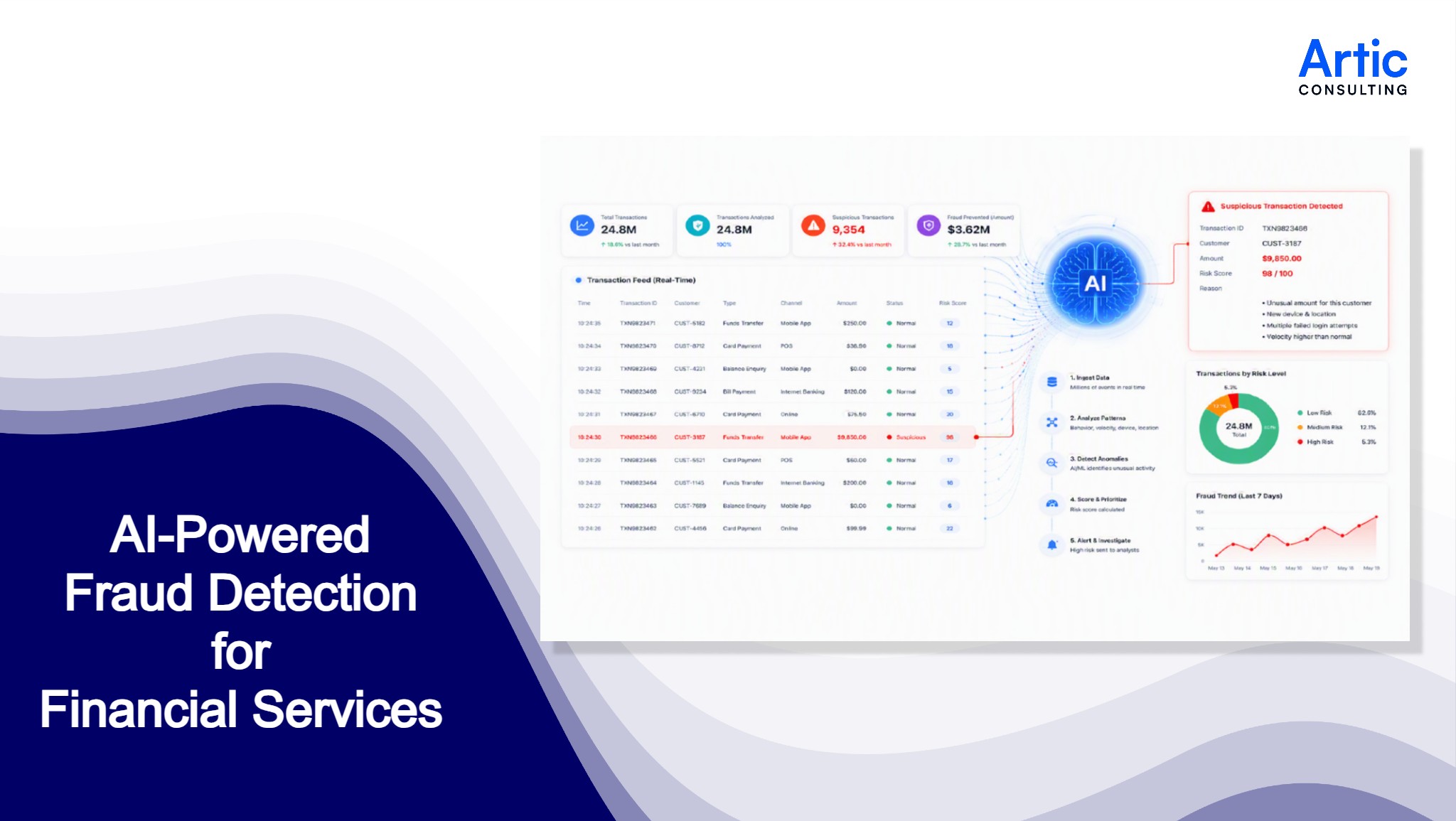
AI helps by looking at patterns across account activity, transactions, and customer behavior, highlighting situations that deserve a closer look. It doesn’t replace fraud analysts. It gives them another way to spot potential issues before they grow into larger problems.
Why Traditional Fraud Detection isn’t Always Enough
Over the years, banks have relied on rule-based fraud detection systems to help spot suspicious activity.
There’s a rule for one thing, another rule for something else, and eventually hundreds of conditions working in the background. The problem is that fraudsters adjust too. They pay attention to the same patterns institutions are watching.
At some point, adding another rule starts delivering smaller returns. Teams end up with more alerts, more reviews, and more work, but not necessarily more visibility into what is actually happening.
That’s one reason the conversation has shifted toward AI-powered fraud detection. Not because rules stopped working, but because they’re not always enough on their own anymore.
As fraud tactics become more sophisticated, many institutions are looking beyond traditional approaches to strengthen their banking fraud prevention efforts. The goal isn’t simply to generate more alerts, but to understand which risks deserve attention first.
This is also where real-time fraud detection is becoming increasingly important. When suspicious activity unfolds across multiple accounts, devices, or transactions, waiting for a manual review can slow down investigations and increase risk.
How AI Detects Fraud in Banking and Financial Services
That’s where AI has become useful for many financial institutions.
According to Microsoft’s guidance on AI for financial services, machine learning models can help organizations identify anomalies, surface suspicious activity, and improve risk detection across large datasets.
Rather than reviewing individual alerts one at a time, AI can support real-time fraud detection by analyzing activity across accounts, transactions, and systems.
Many of today’s machine learning fraud detection capabilities are designed to process large volumes of data and identify relationships that might otherwise be missed during manual reviews. By combining transaction monitoring with fraud analytics, financial institutions can gain a clearer understanding of suspicious activity and investigate potential threats sooner.
Behavioral Baselines
Ask a fraud investigator about a suspicious transaction, and one of the first questions is usually, “Is this normal for this customer?”
That’s essentially what AI is trying to answer.
Through customer behavior analysis and behavioral analytics, AI can learn how customers typically use their accounts.
It can see where they usually log in from, how often they transact, the types of purchases they make, and other patterns associated with their activity.
When something falls outside that established behavior, the activity may be flagged for review.
Pattern Recognition
Fraud investigators rarely make decisions based on a single event. The real story often appears when multiple events are viewed together.
A password change may not mean much. Neither does a replacement card request. But when those actions are followed by unusual account activity, the situation starts to look different.
AI can help connect those events across systems, supporting fraud analytics and helping teams identify potential account takeover attempts earlier.
Anomaly Detection
Not all fraud follows a known pattern. Sometimes investigators discover a problem simply because something looks out of place.
An account becomes unusually active. Transaction volumes increase unexpectedly. Customer behavior changes in a way that doesn’t match historical activity.
AI can continuously monitor these types of changes using anomaly detection and transaction monitoring techniques.
Continuous Learning
One challenge in fraud prevention is that fraudsters rarely keep using the same methods for long.
As new schemes emerge, financial institutions need ways to adapt their detection capabilities.
This is one reason many organizations are investing in machine learning fraud detection capabilities.
How Artic Helped a BFSI Firm Strengthen Fraud Detection
A leading U.S.-based BFSI organization was facing challenges that many financial institutions recognize today. While the company served millions of customers across banking, wealth management, and insurance, its operations were increasingly constrained by legacy systems, fragmented data, growing security concerns, and rising customer expectations.
The organization wanted to modernize its technology landscape, improve access to real-time insights, strengthen fraud prevention capabilities, and deliver more personalized customer experiences. However, disconnected systems made it difficult to create a unified view of the business, slowing decision-making and limiting operational agility.
To address these challenges, Artic Consulting partnered with the organization on a Microsoft-powered transformation initiative. Applications and data were migrated to Microsoft Azure, Power BI dashboards were introduced to support real-time analytics, and Azure AI and Machine Learning capabilities were implemented to help identify unusual activity and strengthen fraud detection efforts.
What Changed After the Implementation
It’s easy to look at a project like this and focus on the technology.
Did the platform go live? Did the dashboards work? Were the fraud alerts accurate?
Those things mattered, but they weren’t what employees noticed first.
What changed was the amount of time people spent chasing information. Teams no longer had to pull data from different systems or wait for reports to arrive before making a decision. Much of what they needed was already available when they started their day.
The organization later reported:
- 50%+ of manual workflows automated, reducing the time spent on reporting, compliance, and other repetitive operational tasks.
- 40% reduction in fraudulent transactions through Azure Security and AI-driven fraud detection capabilities, helping teams identify suspicious activity more effectively.
- 25% increase in customer satisfaction by using Dynamics 365 and AI-powered analytics to deliver more personalized customer experiences.
But day to day, the impact felt less like a statistic and more like fewer delays, fewer manual handoffs, and fewer situations where teams were working with incomplete information.
Fraud detection became stronger, but so did reporting and operational visibility. What started as a fraud prevention initiative ended up improving how teams worked across the business.
Final Takeaways for Financial Services Organizations
One thing stands out from all of this.
Fraud is rarely the only problem a financial institution is trying to solve.
When teams struggle to investigate suspicious activity, the root cause isn’t always the fraud process itself. Sometimes it’s hard to access information. Sometimes data lives in different systems. Sometimes people spend more time looking for answers than acting on them.
The other thing that’s easy to overlook is that fraud doesn’t always arrive with a warning sign attached to it. More often, it hides in routine activity. A transaction that looks normal. A login that seems harmless. A change that doesn’t appear important until someone sees it alongside other events.
That’s why many financial institutions are taking a broader view of fraud prevention. The conversation is becoming less about adding another rule and more about helping teams understand what’s happening across the business.
Fraud detection is often part of a much larger transformation journey. As financial institutions modernize operations, improve customer experiences, and strengthen security, technologies such as AI, cloud platforms, and advanced analytics increasingly work together to support business goals.
For organizations looking at broader modernization initiatives, our article, “Revolutionize Financial Services with Microsoft Solution Partners,” explores how Microsoft technologies help financial institutions drive innovation, improve operational efficiency, strengthen compliance, and accelerate digital transformation.
Exploring What’s Possible with Data and AI?
Whether you’re focused on fraud prevention, analytics, or modernization, small improvements in how information is connected and used can have a bigger impact than you might expect.
FAQs
Can AI completely prevent fraud in banking and financial services?
No. AI isn’t a guarantee that fraud will never happen. What it can do is help teams detect unusual activity earlier and investigate potential issues faster. Many financial institutions use AI to add another layer of visibility, especially when dealing with high transaction volumes and changing fraud patterns.
Why is data visibility important for fraud detection?
Fraud investigations often involve more than one system. When account activity, transaction data, and customer information are spread across different places, it takes longer to understand what’s happening. Having that information easier to access helps teams investigate issues faster.
What results can financial institutions expect from AI-powered fraud detection?
The results depend on the organization and the challenges it’s trying to solve. Some teams use AI to identify suspicious activity earlier, while others use it to reduce the amount of manual review required. In the BFSI case study discussed in this article, the organization reported a 40% reduction in fraudulent transactions after implementing Azure Security and AI-driven fraud detection capabilities.
Get started
Ready to level-up your business?

Amit Giri has 14 years of experience helping organizations navigate technology decisions and align solutions with business goals. His interests include artificial intelligence, Microsoft technologies, cloud solutions, data analytics, digital transformation, and process improvement. Through Artic Insights, Amit shares practical perspectives on using technology to solve real-world business challenges and create lasting value.