Key Summary
- AI ROI is not always obvious. It often appears through a series of smaller improvements over time.
- Many businesses first notice value in reporting, automation, customer support, and day-to-day productivity.
- Saving time is important, but it’s rarely the only outcome. Other benefits often emerge after implementation.
- Similar AI projects can produce different results depending on the business problem, data, and adoption.
- The strongest AI initiatives usually start with a real business challenge, not the technology itself.
AI projects can look impressive on paper. A new tool gets introduced. A process gets automated. A team starts using AI to move faster. For a while, it feels like progress.
But sooner or later, someone asks the question that matters most.
What did we actually get from this?
That’s where AI ROI becomes tricky.
The value is not always obvious right away. Sometimes it shows up as saved time. Sometimes it means fewer manual steps, better reporting, faster customer responses, or employees spending less time digging through systems for information.
And sometimes, the value is harder to separate from the rest of the business.
Many organizations invest in AI to improve reporting, automate workflows, and support better business management decisions across departments.
That’s why measuring the ROI of AI consulting needs more than a simple before-and-after calculation. It means looking at what changed, where the business improved, and whether the solution is still useful after the initial rollout.
Good AI consulting should not just help a company use AI. It should help the business understand where AI makes sense, what results to expect, and how to measure whether those results are actually happening.
In this blog, we’ll break down what AI ROI can look like, where businesses often see returns, and what makes some AI consulting projects more successful than others.
What Does ROI Actually Look Like in an AI Consulting Project?
A lot of businesses expect AI ROI to be obvious.
Sometimes it is.
If a team spends five hours every week creating reports and that drops to one, the value is fairly easy to see. But most projects aren’t that clean.
A reporting initiative might start because reports take too long to produce. A few months later, reporting is faster, but that’s not the only thing people notice. Teams aren’t spending as much time pulling data together. Managers aren’t waiting days for updates. Meetings that used to focus on gathering information are now focused on discussing it.
Nobody usually plans for those outcomes at the beginning, but they still matter.
That’s what makes AI ROI harder to pin down than a typical software purchase.
The value often shows up in day-to-day work. Small delays disappear. Manual steps get removed. People spend less time chasing information and more time using it.
Those changes don’t always fit neatly into a spreadsheet, but they’re usually the first things employees notice after an AI project goes live.
The Five Areas Where Businesses Typically See ROI
Ask five different companies where they saw value from an AI project, and you’ll probably get five different answers.
One team talks about reporting that no longer takes half a day to complete. Another points to fewer manual steps in a process that everyone used to complain about. Someone else mentions faster customer response times or less time spent searching for information.
Even though the results vary between organizations, there are a few places where businesses tend to notice the difference first.
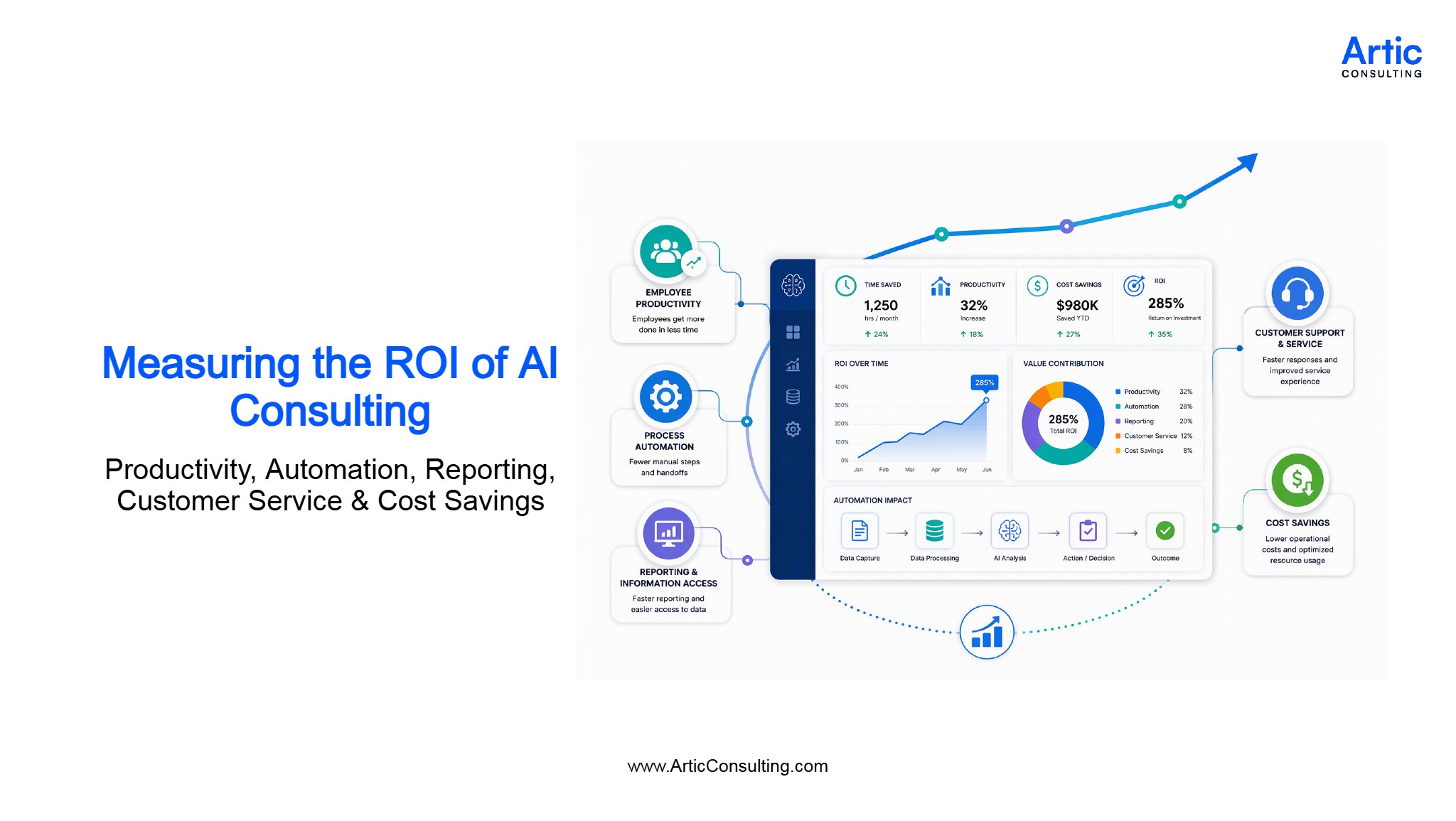
1. Employee Productivity
One manufacturing client wasn’t looking to “improve productivity.” They simply wanted to spend less time creating weekly reports.
McKinsey estimates that generative AI could add up to $4.4 trillion in annual productivity value across enterprise use cases.
That kind of use case is fairly common. Employees often lose time on meeting notes, document creation, email responses, and pulling information from different systems. AI doesn’t remove the work entirely, but it can reduce how much effort goes into it.
When businesses talk about ROI here, they’re usually looking at one thing: whether employees are getting time back during their week.
2. Process Automation
Some of the most noticeable AI wins come from tasks that nobody really enjoys doing in the first place.
A team enters the same information in multiple places. Someone spends part of every morning reviewing documents or forwarding requests to the next person in the process. These activities don’t usually attract much attention because they’ve become normal.
That changes when fewer people have to touch the work to get it completed.
Instead of spending time on routine handoffs and administrative steps, employees can focus on the task itself. For many businesses, this is where ROI starts becoming visible because the process simply feels less frustrating than it did before.
3. Reporting and Information Access
Most companies aren’t short on data. If anything, they have too much of it.
The challenge is that information is often scattered across reports, spreadsheets, emails, and different systems. Before a discussion can happen, someone usually has to pull everything together first.
This is why reporting is often one of the earliest areas where teams notice change. Information becomes easier to find, reports take less effort to prepare, and employees spend less time searching for updates. The work doesn’t disappear, but it usually takes less effort than it did before.
4. Customer Support and Service
Customer support teams often spend as much time looking for information as they do responding to customers.
A question comes in, records need to be checked, previous interactions need to be reviewed, and information may sit across multiple systems. None of that is unusual, but it can slow down the response.
When teams can find answers more quickly, the customer notices the difference. The conversation moves faster, fewer follow-ups are needed, and employees spend less time switching between tools while trying to help someone. Small improvements like these often have a bigger impact than businesses expect.
5. Cost Savings
Cost savings don’t always show up on day one.
In many cases, they appear gradually as other improvements start adding up. Less time spent on manual work. Fewer hours dedicated to repetitive tasks. Reduced reliance on work that previously required additional resources or outside support.
That’s why businesses don’t always connect AI projects to cost reduction immediately. The savings tend to come from dozens of small efficiencies rather than one dramatic change.
Over time, those smaller improvements can add up to a meaningful financial impact.
While the specific outcomes vary from one organization to another, most AI consulting projects tend to create value in a handful of common areas.
88% of organizations now use AI in at least one business function, yet only about one-third have scaled AI across the enterprise.
The table below highlights where businesses typically see ROI and how that impact is often measured.
|
Area |
Typical AI Use Cases |
How Businesses Often Measure ROI |
|
Employee Productivity |
Meeting summaries, report creation, content drafting, information search |
Time saved, reduced manual work, faster task completion |
|
Process Automation |
Data entry, approvals, document processing, workflow automation |
Fewer manual steps, shorter process times, reduced administrative effort |
|
Reporting & Information Access |
Data aggregation, reporting, dashboards, analytics |
Faster reporting, reduced time spent gathering information, quicker access to business data |
|
Customer Support & Service |
Customer assistance, case routing, self-service support, knowledge retrieval |
Faster response times, reduced resolution times, improved service consistency |
|
Cost Savings |
Automation of repetitive work, reduced outsourcing, process optimization |
Lower operational costs, reduced labor effort, fewer resources required for routine tasks |
Why Similar AI Projects Can End Up with Very Different Results
It’s interesting how two businesses can roll out almost the same AI solution and come away with completely different opinions about it.
One team talks about how much faster work has become. The other wonders what all the excitement was about.
Usually, the difference isn’t the software.
Sometimes an AI project starts because everyone feels they should be “doing something with AI.” A tool gets introduced, people try it for a few weeks, and then it quietly becomes another application sitting on the desktop.
In another company, the conversation starts somewhere else.
Someone is tired of spending half a day putting together reports. Customer requests are taking longer than they should. Employees keep entering the same information in multiple places. The technology comes later, after the problem is already clear.
That changes the way success gets measured.
There’s another piece that often gets overlooked.
People don’t automatically change the way they work just because a new tool is available. They need time to figure out where it fits into their day, what they can rely on it for, and where they still need to step in themselves.
The businesses that get the most from AI tend to keep adjusting as they go. They solve one problem, learn from it, and then decide where AI can help next instead of trying to transform everything at once.
Conclusion
Figuring out the ROI of AI consulting is not just about comparing numbers. It means noticing easier routines, saved time, and growth that often happens quietly. The true value of AI appears bit by bit, making daily tasks simpler and work more rewarding. The best AI projects begin with a clear purpose and deliver steady improvements.
These may show up in more efficient processes, better reports, or customers who feel heard. Over time, those results help teams focus on what really matters rather than just tracking spreadsheets.
Not Every AI Project Needs to Be a Big Transformation
In many cases, the best place to start is with a process that’s taking longer than it should. A report people dread putting together. A workflow that still depends on manual updates. A team spending too much time looking for information.
At Artic Consulting, we help businesses figure out where AI fits, where it doesn’t, and what success should actually look like before any technology decision is made.
FAQs
1. If AI is saving time, is that enough to count as ROI?
Not necessarily. Saving time is often the first thing people notice, but it’s only part of the picture. The bigger question is what happens with that time afterwards. If reports are finished faster, employees can focus on other work. If routine tasks require less effort, teams can handle more without adding headcount. That’s usually where the conversation becomes more interesting.
2. Why do some teams see value from AI faster than others?
In many cases, it comes down to the problem they started with. A team that spends hours every week creating reports may notice a difference fairly quickly. A team trying to change a larger process may take longer to see results. The technology can be similar in both situations, but the path to value often looks very different.
3. Is it possible to estimate AI ROI before implementation?
You can make an educated guess, but not a precise calculation. Most teams look at the current process first. If people are spending hours every week on reporting, approvals, or manual updates, that’s usually the starting point for estimating potential value.
Get started
Ready to level-up your business?

Amit Giri has 14 years of experience helping organizations navigate technology decisions and align solutions with business goals. His interests include artificial intelligence, Microsoft technologies, cloud solutions, data analytics, digital transformation, and process improvement. Through Artic Insights, Amit shares practical perspectives on using technology to solve real-world business challenges and create lasting value.