Key Summary
- Business management consulting usually starts when things feel harder than they should, not necessarily when something is broken.
- As companies grow, issues around processes, systems, and visibility tend to show up whether they plan for them or not.
- These problems are often not easy to fix internally because they are tied to how teams and tools have evolved over time.
- Microsoft tools help in different ways, but the real value comes when they are used together and actually fit how the business works.
- In most cases, improvement is not about replacing everything, it is about making what already exists work better.
If you ask ten different people what business management consultants do, you are likely going to get ten different answers (more or less). Some would say they help business grow. Others probably would say they improve operations, reduce costs, or do some lead transformation initiatives.
Well, the answer is not one of the above, it’s all of the above. Basically, business management consulting is mostly about helping organizations figure out what’s preventing them from operating as effectively as they could be and then creating a practical plan to improve it.
For some organizations, the challenge is inefficient processes. And for others, it’s disconnected systems, limited visibility, slow decision-making, or maybe even keeping up with growth.
Sometimes, everything’s just fine and businesses simply need an outside perspective to identify opportunities that may not be so obvious from inside the organization.
To be honest, the conversation has also changed quite a bit in the last few years. Earlier, recommendations were enough, but now, businesses need technology that can efficiently support those improvements and help teams put them into practice.
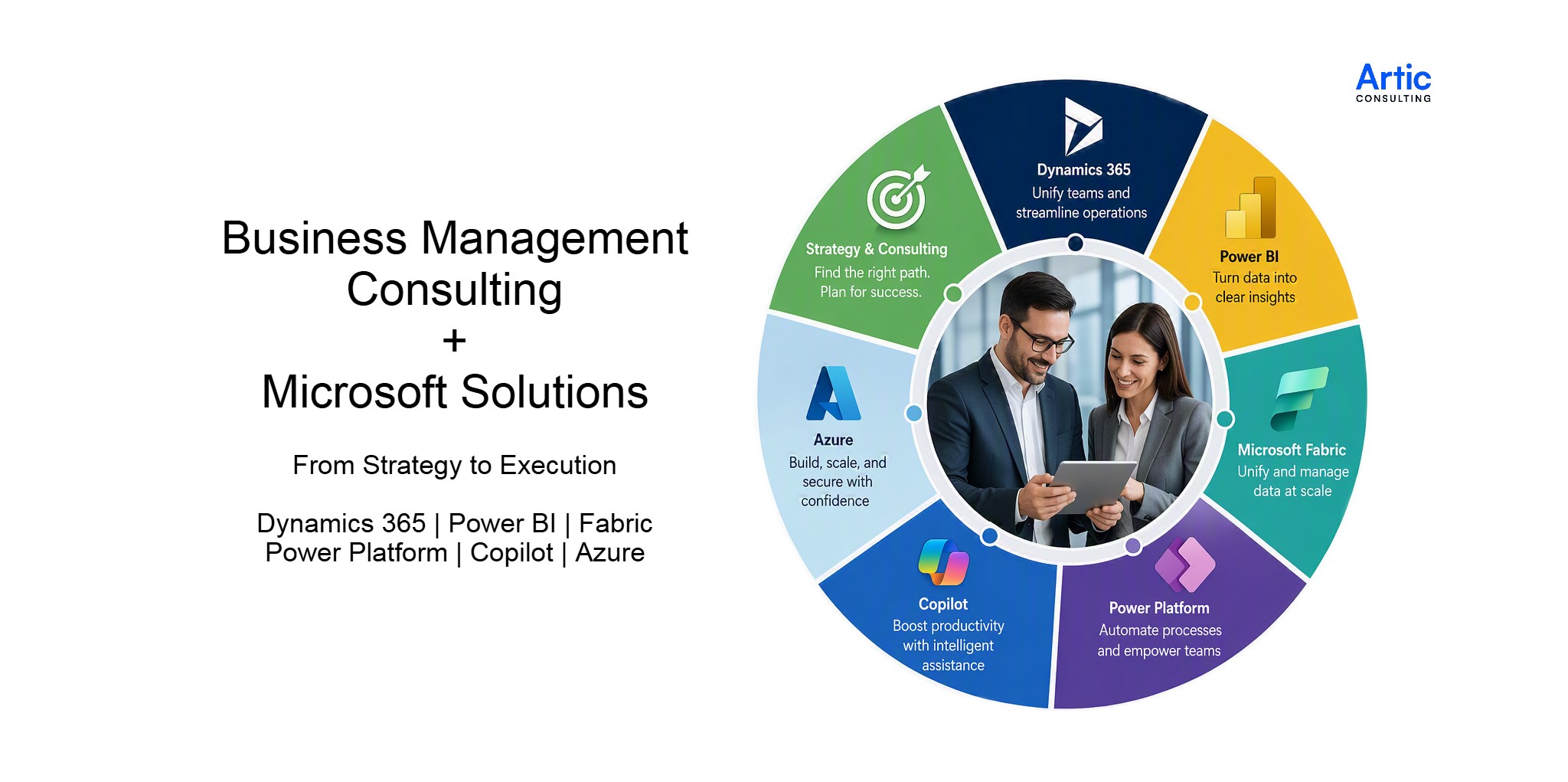
And that’s exactly where platforms like Microsoft Dynamics 365, Power BI, Microsoft Fabric, Power Platform, and Copilot often become part of the discussion.
As a Microsoft Solutions partner, Artic works with such businesses that are trying to solve many of these challenges every day. That’s why we decided to assist you with what business management consulting actually involves, where businesses typically need support, and how Microsoft solutions help turn strategy into action.
What is Business Management Consulting?
Business management consulting is one of those terms that sounds much broader than it actually is. At a basic level, it comes down to this. It’s about bringing in an outside perspective to figure out what’s not working as well as it should and then doing something about it.
For one company, that might mean fixing a process that has slowly become harder to manage over time. For another, it could be cleaning up how data is used, updating older systems, or helping teams work better together as the business grows.
There isn’t a single way this shows up. Every business has its own set of problems, and those problems don’t always look the same from the outside.
But the end goal tends to stay consistent.
You step back, look at how things are actually running today, and try to make operations, systems, and decisions work a bit more smoothly than they currently do.
Business Management Consulting Services include:
- Strategy and planning
Helping teams figure out where to focus next, whether that’s growth, new markets, or fixing something that isn’t working. - Operations improvement
Looking at day-to-day processes and finding ways to make them less complicated, faster, or more consistent. - Data and reporting
Organizing data so it’s actually useful, not scattered across systems or stuck in spreadsheets no one trusts. - Technology and systems
Reviewing existing tools, recommending better fits, or helping implement platforms like CRM, ERP, or analytics solutions. - Process design and automation
Simplifying workflows and reducing manual work where it slows teams down. - Change management
Supporting teams as changes roll out so people actually adopt new ways of working. - Financial and performance analysis
Understanding where money, time, and effort are going and where improvements can be made. - Project and program support
Helping large initiatives stay on track when internal teams are already stretched. - Organizational alignment
Making sure teams, roles, and responsibilities are clear as the company grows.
Common Challenges Business Management Consultants Help Solve
Growth usually brings new opportunities, but it also makes some existing issues more visible.
Things that worked fine earlier don’t always hold up the same way. Processes start feeling harder to manage, information gets scattered across teams, and decisions don’t happen as quickly as they used to.
Most growing businesses run into some version of this. It’s not unusual. It’s usually the stage where people start realizing that something needs to be fixed, not just managed day to day.
Lack of visibility across the business
A lot of growing companies struggle to answer what should be a simple question: “What’s actually going on right now?” Different teams collect information differently. Sales might have one version of the numbers, finance another, and operations something else entirely.
None of the reports are necessarily wrong, but they don’t always tell the same story. Managers end up chasing updates, asking for revised reports, and spending time piecing information together. When getting a clear picture becomes difficult, making quick decisions becomes difficult too.
Processes become more complicated
As a business grows, things just start taking more effort than they used to. Something that used to be handled by one person now needs input from a few different teams. More steps get added along the way. People double-check things more often, and there’s a lot more back-and-forth than before.
Individually, none of this feels like a big deal. It just feels normal at the time. But over a period of time, it adds up. You start noticing that routine work is taking longer than it used to, even though from the outside, the process hasn’t really changed much.
How Microsoft Solutions Help Address These Challenges
By the time these issues start showing up, most businesses already have a sense of what is not working. The gaps are visible, whether it is in reporting, processes, or how teams share information. The difficulty is that these problems are usually tied to the systems in place, not just the way people are working.
This is where Microsoft business solutions tend to come in. Each tool focuses on a different part of the problem, but the idea is to make things work together better instead of adding more layers.
Microsoft Dynamics 365
This is usually where businesses start, especially when teams are using completely different systems. Instead of sales, finance, and operations all maintaining their own data separately, Microsoft Dynamics 365 brings those pieces closer together.
It doesn’t force everything into one rigid setup, but it does reduce the constant need to cross-check numbers or track things in multiple places. For a lot of teams, that alone removes a fair amount of friction.
Useful Read – How Microsoft Dynamics 365 Transforms Businesses
Power BI
Reporting tends to get messy once data starts coming from different places. Someone builds a report, someone else questions it, then another version gets created. It becomes a cycle.
Power BI helps break that a bit. People stop waiting on reports and start working directly with dashboards. It’s not perfect, but it usually makes it easier to see what’s going on without too much back-and-forth.
Microsoft Fabric
This one shows up more when data becomes difficult to manage at scale. Instead of stitching together different systems every time something needs to be analyzed, Microsoft Fabric solutions gives a more consistent place to handle that work. It doesn’t simplify the business itself, but it reduces the effort needed to move data around.
Microsoft Power Platform
A lot of inefficiency sits in small steps that no one notices at first. Things like approvals, document updates, or simple routing between systems don’t seem like a big deal individually. But they keep adding up.
Power Platform tools help take those smaller pieces off people’s plate. Some workflows just run without needing constant follow-up, which makes day-to-day work feel lighter.
Microsoft Copilot for Business
Then there’s the work that isn’t complex, just repetitive. Drafting emails, summarizing updates, pulling information together for meetings. These tasks don’t stand out, but they take time. Copilot fits into that space. It helps speed those things up without changing how people work too much, which is why teams tend to adopt it more easily.
Useful Read – How Copilot in Dynamics 365 Improves Business Decision-Making
Azure
This is less visible day to day, but it matters more as things grow. When systems, users, and data all increase, something needs to hold that together in the background. That’s usually where Azure comes in. It supports everything else without forcing a redesign every time the business expands.
Why Businesses Choose to Work with Artic Consulting
At some point, most businesses already know where things are not working as well as they should. The real challenge is figuring out how to fix those issues without slowing everything else down.
Artic works with businesses that are already dealing with these kinds of challenges and need more than just direction. They need help getting from where things are today to something that actually works better in practice.
It’s not just about suggesting changes
One of the reasons businesses look for a business management consulting partner is because internal teams already have ideas. What is often missing is the time and structure to follow through on those ideas properly.
Artic tends to get involved at that point, not just to suggest what could change, but to help move things forward in a way that actually fits how the business operates.
Combining consulting with Microsoft solutions
A lot of improvements depend on both process changes and the systems behind them. Instead of treating those separately, Artic works across both areas. That usually means helping teams rethink how something should work, and then making sure the right Microsoft tools support that change.
For most businesses, the value is in connecting those two pieces rather than handling them in isolation.
Experience with similar problems
Many of the challenges here are not unique. Disconnected systems, reporting delays, manual work, and slow decision-making tend to show up in similar ways across different organizations.
Working with a consulting partner means those patterns are easier to recognize. There is less trial and error, and decisions are not starting from scratch every time. External consultants often bring that broader experience and perspective, which internal teams may not always have time to build.
An outside perspective that is easier to act on
When teams are working inside the business every day, it can be difficult to step back and look at things objectively.
Having someone external involved can make it easier to question what is currently in place and identify what actually needs to change. That outside view is one of the key reasons many organizations bring in business management consulting support in the first place.
Something not working the way it should?
Sometimes it just takes a step back to see what’s really going on and where things can improve.
FAQs
What does a business management consultant actually do?
A big part of the work is figuring out what’s not working as well as it should and why. That can be anything from how teams collaborate to how systems are being used. From there, it’s about helping put changes in place, not just suggesting them.
When should a business consider management consulting?
Usually when things start feeling harder than they used to. Work takes longer, decisions slow down, or teams don’t seem fully aligned. It doesn’t always mean something is broken, just that the current way of working is starting to struggle as the business grows.
How do Microsoft tools fit into business management consulting?
They usually come in when challenges are tied to systems and data. Tools like Dynamics 365, Power BI, or Power Platform help fix the gaps between teams, improve visibility, and reduce manual work. The value comes from using them in the right way, not just implementing them.
Get started
Ready to level-up your business?

Amit Giri has 14 years of experience helping organizations navigate technology decisions and align solutions with business goals. His interests include artificial intelligence, Microsoft technologies, cloud solutions, data analytics, digital transformation, and process improvement. Through Artic Insights, Amit shares practical perspectives on using technology to solve real-world business challenges and create lasting value.