AI costs are easy to ignore when usage is low. Many organizations learn that quickly. A chatbot gets deployed. An internal knowledge assistant goes live. A team experiments with retrieval-based search. At that stage, nobody is worried about AI token cost optimization or LLM cost optimization.
The conversation usually changes later.
The applications that looked inexpensive during testing start supporting more users, more content, and more business processes. New AI agents get introduced. More information gets pulled into prompts. Additional retrieval steps are added to improve responses.
The result is often higher token consumption than anyone expected.
For some organizations, the immediate focus is on model pricing. Others look at prompt optimization or search for ways to reduce AI token usage. Those efforts can help, but they don’t always explain where the spend is really coming from.
Questions about enterprise AI cost management often lead teams deeper into the architecture itself. Is too much information being sent to the model? Are retrieval systems returning more content than necessary? Could RAG optimization, prompt caching, or better AI governance help control consumption?
Those are the kinds of questions organizations are asking as they look for practical ways to reduce LLM costs and improve long-term AI cost optimization.
What Are AI Tokens and Why Do They Matter?
Every time someone interacts with an AI model, tokens are consumed.
Think of tokens as the small pieces of text that AI models read and generate. The prompt uses tokens. The response uses tokens too.
A short question may use only a small number of tokens. A request that includes detailed instructions, conversation history, documents, or retrieved content will use many more.
This matters because most AI platforms charge based on token usage. As AI adoption grows, token consumption grows with it.
A chatbot answering a few questions each day may have a minimal impact on costs. An enterprise application serving thousands of users, processing documents, searching knowledge bases, and coordinating AI agents can generate significantly more tokens.
That is why AI token cost optimization has become an important part of enterprise AI cost management. The more organizations understand how tokens are used, the easier it becomes to identify opportunities for AI cost optimization, LLM cost optimization, and long-term token cost management.
Where AI Token Costs Usually Come From
Many organizations focus on prompts when looking for ways to reduce AI costs. Prompts are certainly part of the equation, but they are rarely the only source of token consumption.
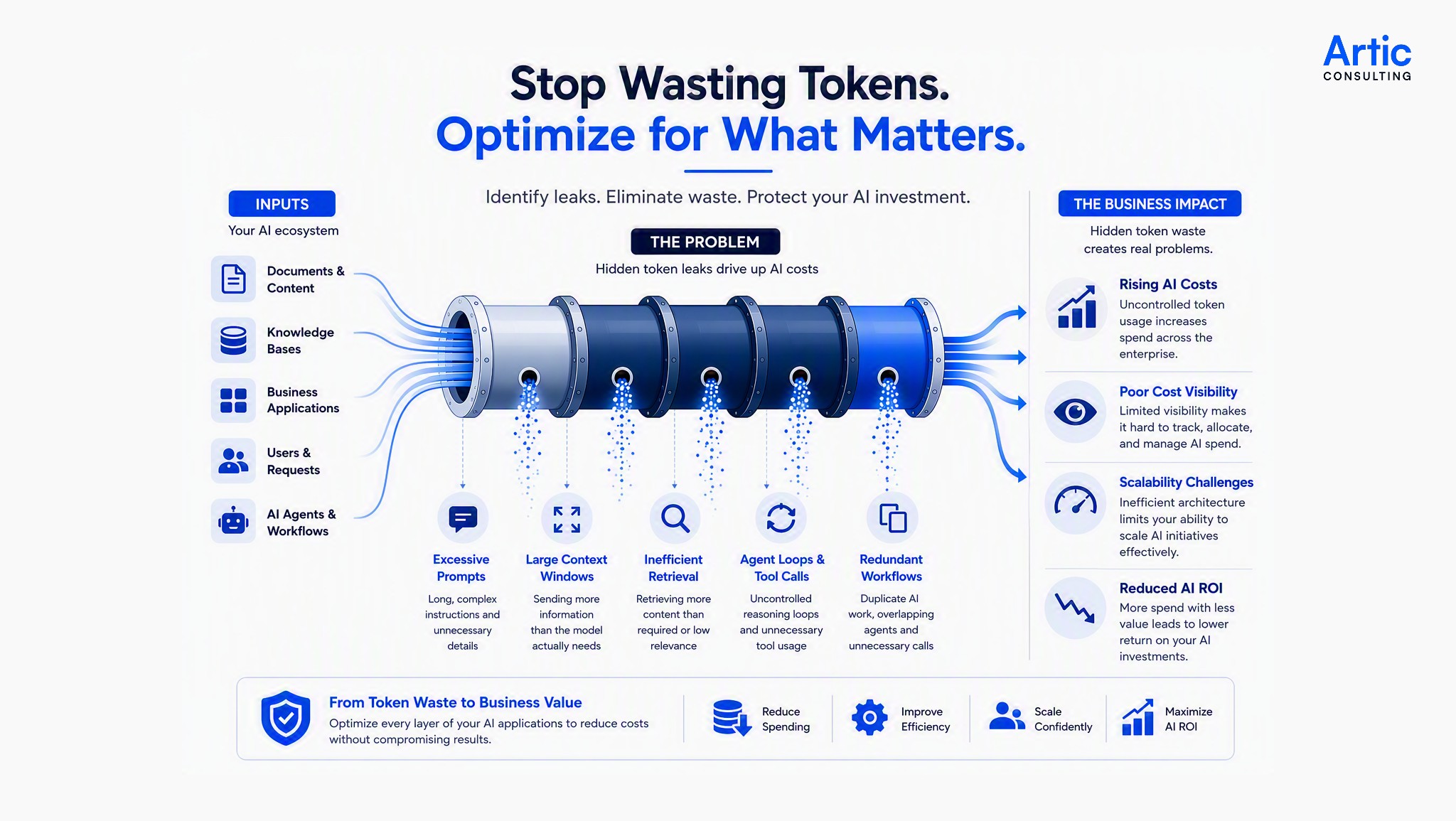
A single user request may trigger several activities behind the scenes before a response is generated. Understanding where those tokens are being used is one of the first steps in effective AI token cost optimization.
User prompts
Every interaction starts with a prompt. The longer the instructions, background information, and input provided by the user, the more tokens are consumed. Detailed prompts can improve response quality, but they also increase usage. This is one reason prompt optimization is often recommended as part of LLM cost optimization.
System prompts
Some token usage comes from instructions running in the background. As applications evolve, those instructions tend to get longer. New rules, examples, and requirements are added over time, increasing token consumption with every request.
RAG context
Retrieval helps AI find relevant information quickly. The problem is that some systems return far more content than necessary. A simple question can end up sending large chunks of documents to the model, increasing usage. This is why RAG optimization is often part of AI token cost optimization efforts.
Conversation history
AI assistants often include previous messages to maintain context. This creates a better user experience, but long conversations can become expensive if large amounts of history are repeatedly sent back to the model. Many organizations reduce AI token usage by summarizing older conversations rather than keeping the entire history.
Tool calls
AI applications frequently connect to external systems such as CRM platforms, ERP systems, databases, and search services. Every tool call can introduce additional information that must be processed by the model, increasing overall token usage.
Agent reasoning loops
Some AI agents do more work than users realize. A request may trigger several behind-the-scenes interactions before a final answer is returned. Those extra interactions consume tokens too. As agent usage grows, this hidden activity can become a noticeable contributor to AI inference costs and overall AI token cost optimization efforts.
Model outputs
Input tokens are only part of the story. The responses generated by the model also consume tokens. Long summaries, detailed reports, and extensive explanations can slowly increase costs, especially in high-volume environments.
Multi-agent workflows
Some organizations use multiple agents that work together to complete a task. One agent retrieves information. Another analyzes it. A third generates the final output.
These architectures can deliver strong results, but they can also increase token consumption if not carefully monitored. As a result, AI agent cost optimization and multi-agent cost management are becoming increasingly important for organizations scaling AI across the business.
15 Common AI Token Cost Optimization Strategies
Once organizations understand where tokens are being used, the next step is finding practical ways to reduce unnecessary usage. Some improvements are comparatively simple. Others may require changes to application design, retrieval patterns, or AI governance practices.
However, the good news is that meaningful savings often come from a combination of small improvements rather than a single major change.
1. Reduce Prompt Length
Long prompts are not always better prompts. Many AI applications accumulate instructions over time. New requirements get added. Extra examples are included. Previous prompts are copied into new workflows.
The result is often a prompt that is much longer than it needs to be. That’s precisely why you should review prompts. It can help remove unnecessary instructions while maintaining response quality. This is one of the simplest forms of AI token optimization and LLM cost optimization.
2. Trim Context Windows
More context is not always better. AI applications usually send large amounts of information to the model because they’re trying to cover every possible scenario. Documents, conversation history, and retrieved content get added whether they’re needed or not.
The problem is that every piece of information consumes tokens. Teams focused on AI token optimization often find that a significant amount of token usage comes from information the model never really needed. This is why RAG optimization and context compression are commonly used to support LLM cost optimization and reduce unnecessary spending.
3. Implement Prompt Caching
Some information doesn’t change from one request to the next. Instructions, templates, reference documents, and system prompts are often reused thousands of times. Processing the same content repeatedly adds to token consumption without creating additional value.
Prompt caching reduces that overhead by allowing previously processed content to be reused instead of sent through the model again. For organizations focused on AI token optimization, it can be a practical way to improve token cost management and lower costs without changing the user experience.
4. Use Smaller Models Where Appropriate
It’s easy to default to the most capable model for every use case. That approach works, but it can also become expensive over time. Not every request carries the same level of complexity. A quick summary, simple classification task, or data extraction request may not need the same model used for deeper analysis.
This is where model routing becomes useful. Different workloads can be matched with different models based on the task at hand. For organizations focused on AI token cost optimization, this can improve LLM cost optimization without affecting the overall user experience.
5. Limit Output Length
Bigger responses are not always more useful. Left unchecked, AI models often generate more detail than a user actually needs. A simple answer can turn into several paragraphs, increasing token usage with every interaction.
Setting reasonable response limits helps keep outputs focused while reducing unnecessary consumption. This is especially useful for chatbots, assistants, and high-volume applications where small savings can add up quickly.
For organizations working on AI token cost optimization, controlling output length is a straightforward way to improve token cost management and reduce overall AI inference costs.
6. Summarize Conversation History
To maintain context in long conversations, AI applications often send previous messages back to the model with every new request. As the conversation grows, token usage grows with it.
A common approach is to replace older messages with a short summary that captures the key points. The model keeps the context it needs without carrying the full conversation history. If your company is focused on AI token optimization, this is a practical way to reduce AI token usage while maintaining a good user experience.
7. Batch Requests
Sometimes the cost comes from how often the model is being called. Instead of sending multiple small requests, some workloads can be processed together in a single request. This reduces the number of model interactions and improves efficiency. The biggest impact is often seen in repetitive or high-volume processes where the same type of request is executed thousands of times each day.
8. Optimize RAG Retrieval
Retrieval is supposed to bring back the most relevant information. In practice, that’s not always what happens. A simple question can end up pulling multiple documents, lengthy passages, or content that has little connection to the request.
The more information sent to the model, the more tokens are consumed. This is why RAG optimization often focuses on improving retrieval quality rather than retrieving more content. Better results and lower token usage can often go hand in hand.
9. Measure Cost Per Business Task, Not Cost Per Token
A lower token count does not always mean a lower cost. Consider two AI applications. One uses more tokens but completes a report in minutes. The other uses fewer tokens but requires multiple retries and manual review before the work is finished.
Looking only at token consumption can hide the bigger picture. Alongside AI token cost optimization, it helps to track the cost of completing actual business tasks, such as generating a report, resolving a support case, or processing a request. That’s often where the value of enterprise AI cost management becomes easier to understand.
10. Eliminate Redundant AI Workflows
AI usage often grows faster than organizations expect. Different teams may build similar assistants, automate the same task in different ways, or run multiple AI workflows to produce nearly identical results. Each workflow adds to overall token consumption.
Reviewing existing AI solutions can help identify overlap and unnecessary processing. In some cases, removing duplicate workloads delivers greater savings than optimizing prompts or models.
11. Control Agent Sprawl
AI agents tend to multiply quickly. One team builds an agent for research. Another creates one for reporting. A third introduces agents to automate approvals or customer interactions. Over time, it becomes difficult to track how many agents are running and what they’re consuming.
Without clear oversight, token usage can grow faster than expected. Regular reviews of AI agents, workflows, and usage patterns can help keep AI agent cost optimization and multi-agent cost management under control.
12. Create Token Budgets for Applications
Most organizations track budgets for cloud infrastructure, software, and projects. AI usage should be treated the same way.
Without clear limits, token consumption can grow gradually until costs become difficult to explain. By introducing token budgeting, teams can monitor usage by application, department, or business process.
The goal isn’t to restrict innovation. It’s to create visibility. When usage trends are easy to see, managing AI token cost optimization and enterprise AI.
13. Remove Unnecessary AI Calls
Not every step in a workflow needs AI. Over time, it’s common to see AI added to tasks that could be handled through business rules, workflow automation, or simple logic. The process works, but each unnecessary model call adds to token consumption.
A quick review of existing workflows often reveals opportunities to simplify the process and reduce costs. In some cases, the best way to improve AI cost optimization is to avoid making the AI call in the first place.
14. Optimize the Entire AI Architecture
Prompts often get most of the attention, but they are only one part of the equation. The way an AI application is designed can have a much bigger impact on token consumption. Retrieval layers, memory handling, model routing, caching, and agent orchestration all influence how many tokens are processed.
This is where AI architecture optimization becomes important. Small architectural improvements can sometimes deliver larger savings than prompt-level changes alone.
15. Track Cost Per User and Cost Per Outcome
Not all AI spending delivers the same value. Two applications may consume a similar number of tokens, yet one saves hours of work while the other has little impact on the business. Looking at token usage alone doesn’t tell the whole story.
Alongside AI token cost optimization, it helps to measure outcomes. How much does it cost to generate a report, resolve a support ticket, process an invoice, or complete a workflow? The answers often provide a clearer picture of AI ROI than token counts alone.
Signs Your AI Environment Has a Token Waste Problem
Not every increase in AI spending points to a serious problem. As adoption grows, costs will naturally grow too.
The challenge is knowing whether those costs are tied to business value or unnecessary token consumption. These signs often indicate that it’s time to take a closer look at your AI token cost optimization efforts.
AI Costs Keep Increasing, But Nobody Knows Why
A rising bill isn’t unusual. Not being able to explain it is. If teams struggle to identify which applications, workflows, or AI agents are driving consumption, there may be a visibility problem.
Similar AI Tools Are Solving the Same Problem
Over time, departments often build their own AI assistants, workflows, or copilots. What starts as innovation can eventually lead to duplicate capabilities, duplicated token usage, and unnecessary costs.
Large Amounts of Content Are Being Sent to Models
Retrieval systems, conversation history, and supporting documents can quietly increase token consumption. If applications routinely send far more information than needed, RAG optimization may be worth investigating.
AI is Being Used for Simple Tasks
Not every decision requires an LLM. If basic routing, validation, or rule-based activities are triggering model calls, there may be opportunities to reduce unnecessary AI usage.
Nobody is Monitoring Token Consumption
Most organizations track cloud spend. Fewer track tokens with the same level of attention. Without usage monitoring, budget controls, or token budgeting, waste can go unnoticed for months.
AI Costs Are Measured, But Business Outcomes Aren’t
A token count only tells part of the story. If teams can see consumption but cannot connect it to productivity improvements, faster processes, or business value, it’s difficult to know whether AI spending is delivering the expected return.
New AI Agents Keep Appearing
One agent becomes three. Three become ten. Without clear ownership and AI governance, agent ecosystems can grow quickly, making multi-agent cost management much more difficult than expected.
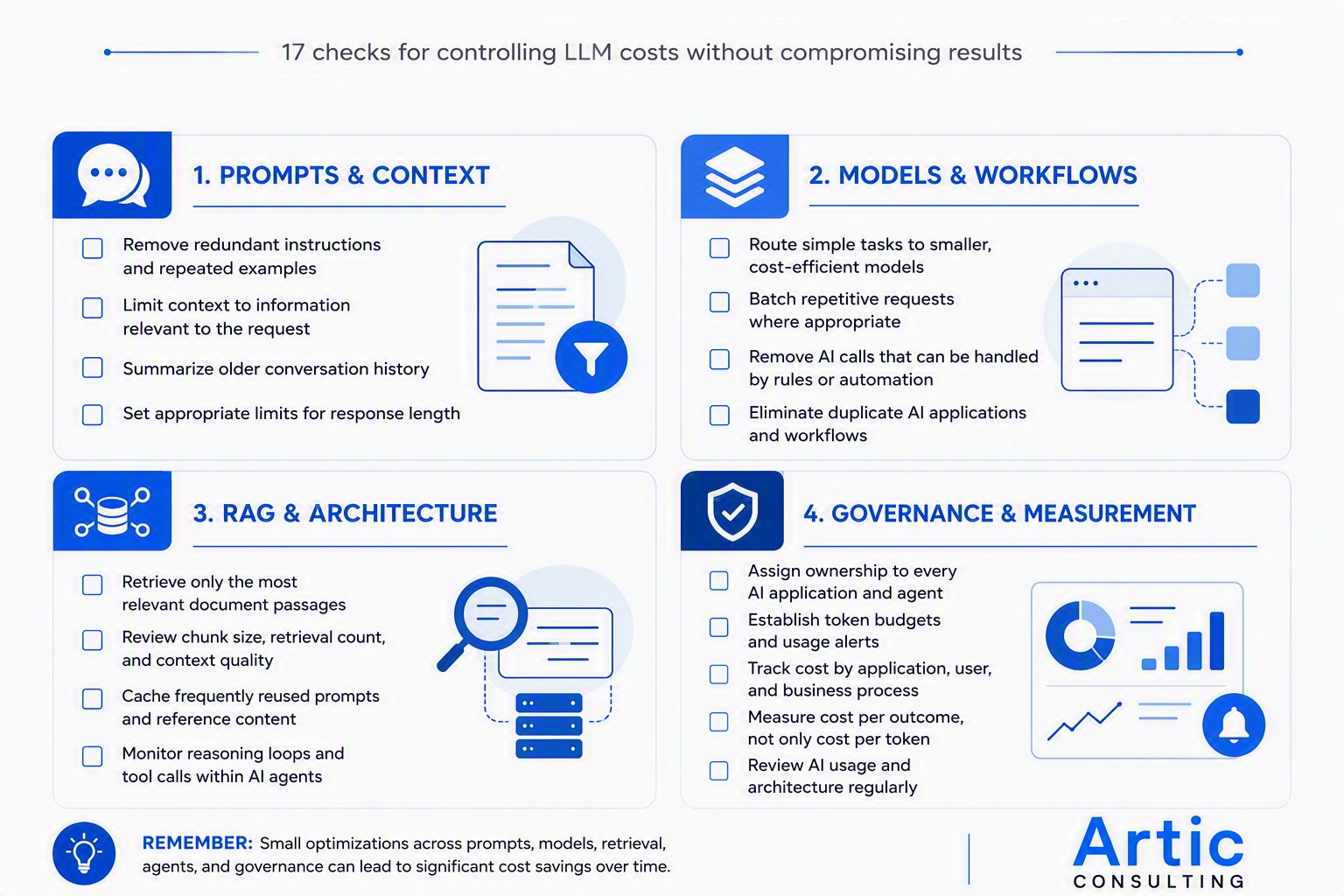
AI Token Cost Optimization Checklist
Conclusion
Most token optimization guides focus on reducing words inside prompts. That definitely helps. But the largest savings often come from looking beyond prompts and examining how AI systems are designed, governed, and measured. Organizations that treat tokens as a business resource rather than a technical metric are usually the ones that achieve sustainable AI adoption while keeping costs under control.
Not sure where your AI spend is coming from?
From AI agents and retrieval systems to Copilot and Azure OpenAI, Artic Consulting helps organizations uncover optimization opportunities without slowing innovation.
FAQs
1. What is AI token optimization?
AI token optimization is the practice of reducing unnecessary token consumption while maintaining response quality and business value. It involves everything from prompt design and retrieval improvements to governance and application architecture.
2. Why are AI token costs increasing?
Growth is usually the biggest factor. Higher usage, longer conversations, larger context windows, additional retrieval steps, and more AI agents all contribute to increased token consumption. Costs can also rise when applications send more information to the model than necessary.
3. How to reduce AI token costs?
Most organizations start by reducing unnecessary context, implementing prompt caching, optimizing retrieval, limiting output length, and reviewing workflows that generate excessive token usage. The biggest savings often come from identifying waste rather than restricting AI usage.
4. Does prompt optimization reduce AI costs?
Yes, but prompt optimization is only one part of AI token cost optimization. In many environments, larger savings come from RAG optimization, model routing, caching strategies, and improvements to workflow design.
5. What is prompt caching, and why does it matter?
Prompt caching allows frequently used instructions and content to be reused instead of processed repeatedly. In high-volume environments, prompt caching cost savings can have a noticeable impact on overall AI spending.
6. What are some RAG token optimization best practices?
A common mistake is retrieving more information than the model actually needs. Strong RAG optimization focuses on improving retrieval quality, reducing irrelevant content, refining chunking strategies, and sending only the most relevant context to the model.
7. How can organizations reduce Azure OpenAI costs?
There is rarely a single fix. Organizations often combine prompt caching, retrieval optimization, model selection, token budgeting, usage monitoring, and AI governance practices to control costs while maintaining performance.
8. What is token budgeting?
Token budgeting establishes usage limits for applications, teams, departments, or workflows. The goal is visibility and control, making it easier to identify unusual consumption patterns before they become larger cost issues.
9. What is enterprise AI token management?
Enterprise AI token management is the process of tracking, monitoring, and governing token consumption across AI applications, users, and business units. It plays an important role in enterprise AI cost management and long-term AI governance.
10. How to measure AI ROI and costs?
Token consumption is only one metric. Many organizations also track the cost of completing business outcomes, such as generating a report, resolving a support case, processing an invoice, or completing a workflow. This provides a clearer picture of value than token counts alone.
Table of contents
- Overview
- What Are AI Tokens?
- Where AI Token Costs Usually Come From
- 15 Common AI Token Cost Optimization Strategies
- Reduce Prompt Length
- Trim Context Windows
- Implement Prompt Caching
- Use Smaller Models
- Limit Output Length
- Summarize Conversation History
- Batch Requests
- Optimize RAG Retrieval
- Measure Cost Per Task, Not Per Token
- Eliminate Redundant AI Workflows
- Control Agent Sprawl
- Create Token Budgets for Apps
- Remove Unnecessary AI Calls
- Optimize the Entire AI Architecture
- Track Cost Per User and Cost Per Outcome
- Signs Your AI Environment Has a Token Waste Problem
- AI Token Cost Optimization Checklist
- Conclusion
- FAQs
Get started
Ready to level-up your business?

Amit Giri has 14 years of experience helping organizations navigate technology decisions and align solutions with business goals. His interests include artificial intelligence, Microsoft technologies, cloud solutions, data analytics, digital transformation, and process improvement. Through Artic Insights, Amit shares practical perspectives on using technology to solve real-world business challenges and create lasting value.