A few years ago, moving to Azure was a big project. Today, that’s no longer the case for many organizations. Azure has simply become part of the way the business operates.
New applications get deployed there. Teams store and analyze data. Developers spin up resources when they need them. Business units adopt new tools and services without giving much thought to the underlying cloud platform supporting them.
That kind of growth is usually a good thing. It means the business is finding new ways to use Azure. At the same time, it can create a situation where Azure cloud management becomes more demanding than expected. Costs are spread across multiple projects, security requirements continue to change, and internal teams are balancing routine Azure administration with the growing list of business requests coming their way.
This is one primary reason why Azure managed services have become an important consideration for many organizations. The conversation is rarely about whether Azure is delivering value. Instead, it’s about whether the environment is being managed in a way that supports future growth, security, performance, and cost control.
As these demands increase, many organizations begin exploring whether an Azure Managed Services Partner could help fill the gaps. If that discussion has started within your organization, the following signs may be worth paying attention to.
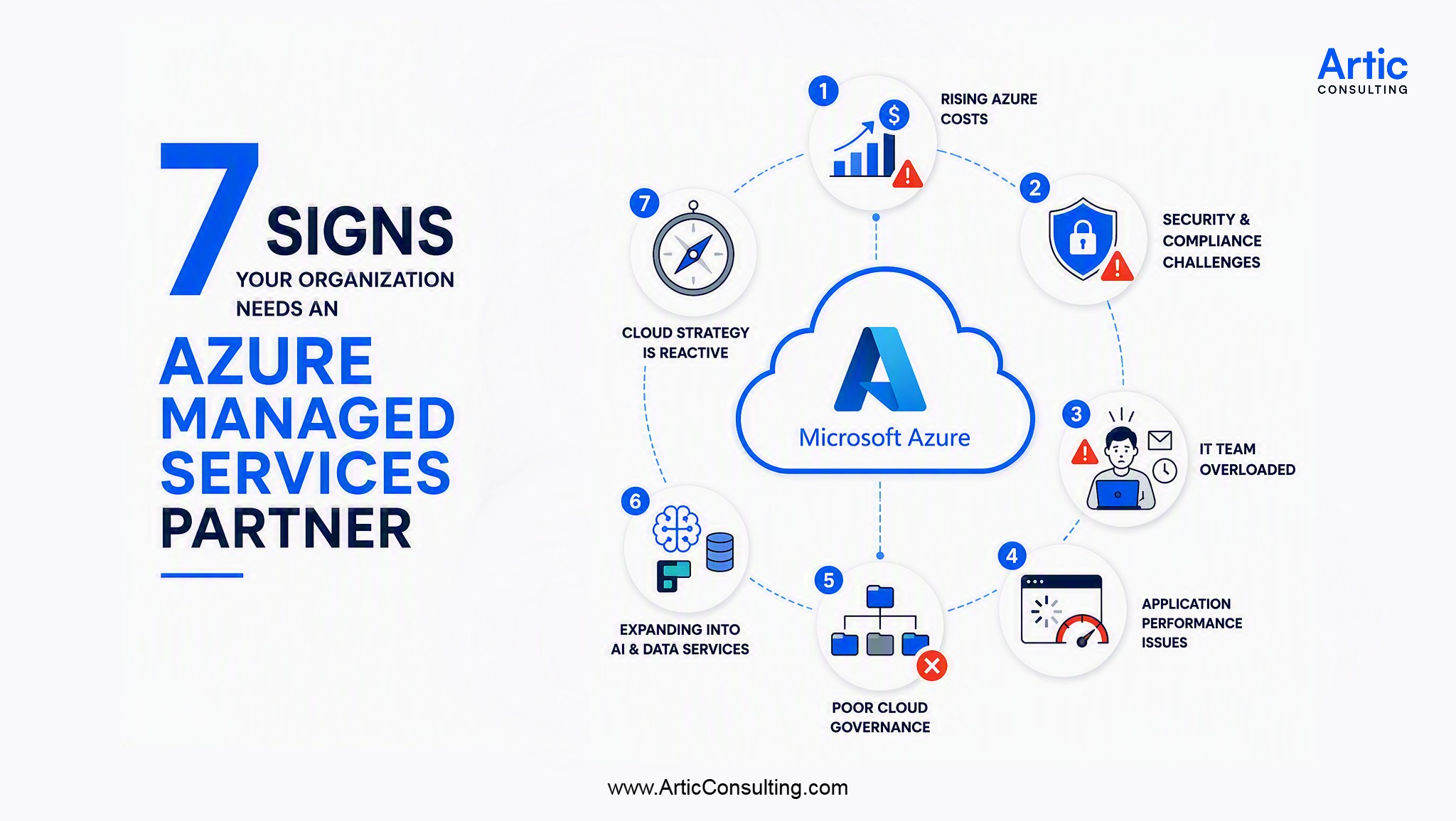
7 Signs You Need a Microsoft Azure consulting services Partner
1. Your Azure Costs Are Increasing, But Visibility is Limited
Most teams expect Azure costs to grow as the business grows. The surprise comes when nobody is completely sure why they’re growing.
A new application gets deployed, extra storage gets added, and different teams start using Azure for their own projects. None of those decisions seem significant on their own. Over time, though, they all show up on the same bill.
It’s not uncommon for cost reviews to end with more questions than answers. In fact, 84% of organizations say managing cloud spend is one of their biggest cloud challenges, according to Flexera’s 2025 State of the Cloud Report.
That’s one reason why Azure cost optimization has become a bigger priority for many organizations. Before costs can be reduced, teams need a clear understanding of what’s driving them in the first place.
2. Security and Compliance Have Become More Difficult to Manage
Security can get messy as an Azure environment grows. For example, a contractor may need access to a system for a short project. The project ends, but the access remains. A few months later, nobody remembers why that account still has permissions.
The same thing can happen across applications, storage accounts, and other Azure resources. Different teams set things up at different times, and over the years it becomes harder to keep track of who has access to what.
Compliance can create similar challenges. An audit request sounds simple until someone has to gather reports, review permissions, and check security settings across multiple systems.
According to Microsoft’s Digital Defense Report, over 600 million cyberattacks are observed every day across Microsoft systems and customers worldwide.
Keeping up with all of this takes time. As Azure environments grow, Azure security management becomes more than just reviewing permissions and responding to alerts. Teams also need to keep track of policies, compliance requirements, user access, and security settings across a growing number of resources.
3. Your Internal Teams Spend Too Much Time on Maintenance
Most IT teams don’t have a shortage of ideas. The problem is finding time to work on them.
One day it’s a server that needs patching. The next day it’s an alert that needs attention. Then an application issue pops up and takes priority over everything else. Before long, the week is gone.
Many teams end up spending so much time keeping things running that projects they actually want to work on keep getting pushed back. Application upgrades get delayed. New Azure features never make it past the planning stage. Improvement projects sit on the to-do list for months.
There’s nothing unusual about maintenance work. The issue is when it starts taking up most of the team’s time.
4. Performance Problems Are Affecting Business Operations
A report that normally takes two minutes now takes ten. An application feels slow after lunch everyday. Teams start refreshing screens because they think something didn’t load properly.
Now this issue might be a resource running out of capacity or an application that needs tuning. Either way, people notice when systems don’t work the way they’re supposed to.
And once enough people start complaining, IT ends up spending time chasing performance issues instead of working on other priorities.
5. Cloud Governance is Inconsistent Across Teams
This usually happens a lot among teams. One team creates resources one way. Another team follows a different approach. A few years later, Azure has grown across the business, but there isn’t always a consistent way of managing it.
For example, someone needs access to a subscription and gets added quickly so work can move forward. Later, another person joins the project and gets similar permissions. Over time, it becomes difficult to see who has access to what and whether those permissions are still needed.
The same thing can happen with naming conventions, resource tagging, security settings, and cost controls. Everyone is trying to get their work done, but different teams end up working in different ways.
6. You’re Expanding into AI, Data, or Advanced Azure Services
A lot of organizations are talking about AI right now. The challenge is that AI projects usually bring other work with them.
Someone wants to build a Copilot solution. A team starts looking at Microsoft Fabric. The business asks for better reporting across multiple systems. What sounds like a single project quickly turns into conversations about data quality, access permissions, storage, and cloud resources.
For example, a company may want to use Azure AI to analyze customer data. The idea sounds straightforward until the team realizes the data sits in different systems and needs to be organized before anything else can happen.
The more Azure services a business adopts, the more there is to manage behind the scenes.
7. Your Cloud Strategy Feels Reactive Instead of Strategic
Some teams spend so much time dealing with immediate needs that there’s little time left to think about what’s next.
A request comes in, so resources get added. A problem shows up, so it’s fixed. Another project needs Azure, so the team finds a way to support it. The work gets done, but most decisions are being made at the moment.
For example, a company may have talked about moving more applications to Azure or improving its data platform years ago. The idea is still there, but day-to-day work keeps pushing it further down the list.
Over time, it becomes harder to answer simple questions. What should be moved to Azure next? Which services are no longer being used? Where should the team focus its efforts over the next year?
What to Look for in an Azure Cloud Consulting Partner
Choosing an Azure Cloud Managed Services Partner isn’t always easy. On paper, many providers offer similar services. The differences usually become clear once you start asking practical questions.
Proven Azure Expertise
One provider may have experience managing virtual machines and backups. Another may be supporting Azure AI, Microsoft Fabric, complex data platforms, and hybrid environments every day.
The easiest way to tell the difference is to ask about real projects. Not certifications. Not marketing slides. Real examples of customer environments they support.
Security and Governance Capabilities
Security often sounds good during the sales process because every provider talks about it.
A better question is what happens after a user leaves the company, a compliance review is scheduled, or a security concern needs to be investigated. Those day-to-day situations usually reveal how mature a provider’s processes actually are.
Cost Optimization Experience
Most organizations don’t expect a provider to magically lower costs. What they do expect is clarity.
If Azure spending increases, the provider should be able to explain why. If resources aren’t being used, they should be easy to identify. Cloud costs shouldn’t feel like a mystery every month.
Proactive Monitoring and Support
A lot of providers look similar until there’s a problem. Maybe the system goes down on a Friday evening. Maybe users can’t access an application on Monday morning. Those are the moments that show what support actually looks like.
Before choosing a provider, ask how support requests are handled and who you’ll be speaking to when something needs urgent attention. Some providers are quick to respond. Others make you work through multiple layers before reaching someone who can help.
Help Beyond Day-to-Day Support
Many companies start with Azure for one reason and end up using it for much more. One year it’s cloud infrastructure. The next year it’s Microsoft Fabric, AI, analytics, or new business applications. The technology keeps changing, and new ideas keep getting added to the list.
It’s helpful to have a partner who understands those conversations and can offer advice based on experience, not just manage support tickets.
How Azure Managed Services Create Long-Term Business Value
The real value of Azure managed services isn’t always obvious in the first few weeks. In some cases, it shows up over time.
Lower Operational Costs
Cloud costs have a habit of growing quietly. A project needs extra resources, more storage gets added, and a few new services are turned on. None of it feels significant at the time. Months later, the Azure bill looks very different from what everyone remembers. Having someone regularly review the environment helps catch those things before they become expensive habits.
Improved Security Posture
Security isn’t something teams set up once and forget about. People join projects, permissions change, and new systems get added. The challenge isn’t usually creating security controls. It’s making sure they still make sense six months later.
Greater Reliability
Most users never send messages saying everything worked perfectly today. They only notice when an application is slow or unavailable. Small performance issues can be easy to ignore, but they add up over time. Consistent monitoring helps catch those problems before they become regular complaints.
Faster Innovation
Ask most IT teams what’s on their wish list and you’ll usually get a long answer. New applications, better reporting, AI projects, automation ideas. The difficult part isn’t coming up with ideas. It’s finding the time to work on them while dealing with day-to-day Azure management.
Better Cloud ROI
Many organizations use Azure every day without taking advantage of everything that’s already available to them. Sometimes the biggest opportunity isn’t adding another service. It’s getting more value from the services and resources that are already in place.
Getting More from Azure Starts with the Right Support
Azure tends to get more complex as the business grows. Costs are harder to track, security needs more attention, and internal teams often have less time for new projects.
At Artic Consulting, we help organizations manage Azure today while preparing for what’s next, from Azure cloud development and data platforms to AI and application modernization.
If some of the challenges in this article feel familiar,
Not sure whether your Azure environment is operating at its full potential?
Artic Consulting helps organizations reduce cloud complexity, strengthen security, optimize Azure costs, and build a clear roadmap for future growth.
Talk with our Azure experts to assess your environment and identify opportunities for improvement.
Conclusion
Most organizations don’t start looking at Azure managed services because of one major problem.
It’s usually a collection of smaller things that build up over time. A growing Azure bill. More security reviews. More support requests. Less time for the projects that have been sitting on the backlog.
If you’re seeing some of those signs, you’re not alone. Many organizations reach the same point as Azure becomes a bigger part of their day-to-day operations.
FAQs
1. Why do Azure costs become harder to manage as an environment grows?
As more applications, users, storage, and services are added, it becomes harder to see where Azure spending is coming from. Different teams may create resources over time, making cost tracking and budgeting more challenging.
2. What are some signs that Azure security management needs more attention?
Common signs include difficulty tracking user access, inconsistent security settings across teams, time-consuming compliance reviews, and growing concerns about security risks as the Azure environment expands.
3. How can Azure managed services help internal IT teams?
A lot of IT teams end up spending more time maintaining Azure than working on new projects. Extra support can help with the day-to-day workload, making it easier to focus on bigger priorities when they come up.
Table of contents
- Overview
- 7 Signs You Need a Microsoft Azure consulting services Partner
- Azure Costs Are Increasing, But Visibility is Limited
- Security and Compliance Have Become More Difficult to Manage
- Your Internal Teams Spend Too Much Time on Maintenance
- Performance Problems Are Affecting Business Operations
- Cloud Governance is Inconsistent Across Teams
- You’re Expanding into AI, Data, or Advanced Azure Services
- Your Cloud Strategy Feels Reactive Instead of Strategic
- What to Look for in an Azure Cloud Consulting Partner
- How Azure Managed Services Create Long-Term Business Value
- Getting More from Azure Starts with the Right Support
- Conclusion
- FAQs
Get started
Ready to level-up your business?

Amit Giri has 14 years of experience helping organizations navigate technology decisions and align solutions with business goals. His interests include artificial intelligence, Microsoft technologies, cloud solutions, data analytics, digital transformation, and process improvement. Through Artic Insights, Amit shares practical perspectives on using technology to solve real-world business challenges and create lasting value.