As a business consultancy, we feel like every AI conversation has moved in the same direction over the past year.
Not long ago, people were asking how AI could help employees write faster, summarize information, or find answers. Now the discussion is increasingly about agents. What if AI could handle parts of a process on its own? What if it could review information, make a recommendation, trigger an action, or complete a task without somebody constantly guiding it?
The excitement is easy to understand. On paper, the possibilities sound impressive.
What’s interesting, though, is what happens once organizations move past the demos.
The conversations start changing. Teams that were initially focused on use cases begin talking about data. Security teams start asking different questions. Business leaders discover that processes aren’t as consistent as they thought. Someone eventually asks who owns the agent once it’s live, and the room usually gets quieter.
That’s also why organizations often find themselves evaluating more than just the technology. They start paying closer attention to the expertise, experience, and guidance needed to navigate those challenges.
Why Agentic AI Feels Different From Previous AI Initiatives
The easiest way to think about it is this:
|
Traditional AI |
Agentic AI |
|
Provides answers |
Takes actions |
|
Supports decisions |
Executes tasks |
|
Requires human follow-up |
Can move work forward |
|
Works within a single interaction |
Can trigger workflows |
|
Assists employees |
Operates within defined boundaries |
That difference sounds subtle, but it changes the conversation pretty quickly.
One reason agentic AI keeps coming up in executive conversations is that it feels like a different category of technology.
With most AI tools, the output is usually the end of the interaction. Someone asks a question, reviews the response, and decides what to do next.
Agents change that dynamic.
Instead of stopping at an answer, they’re often expected to continue the process. That simple shift is what makes the conversations around agentic AI look very different from the conversations organizations were having a year or two ago.
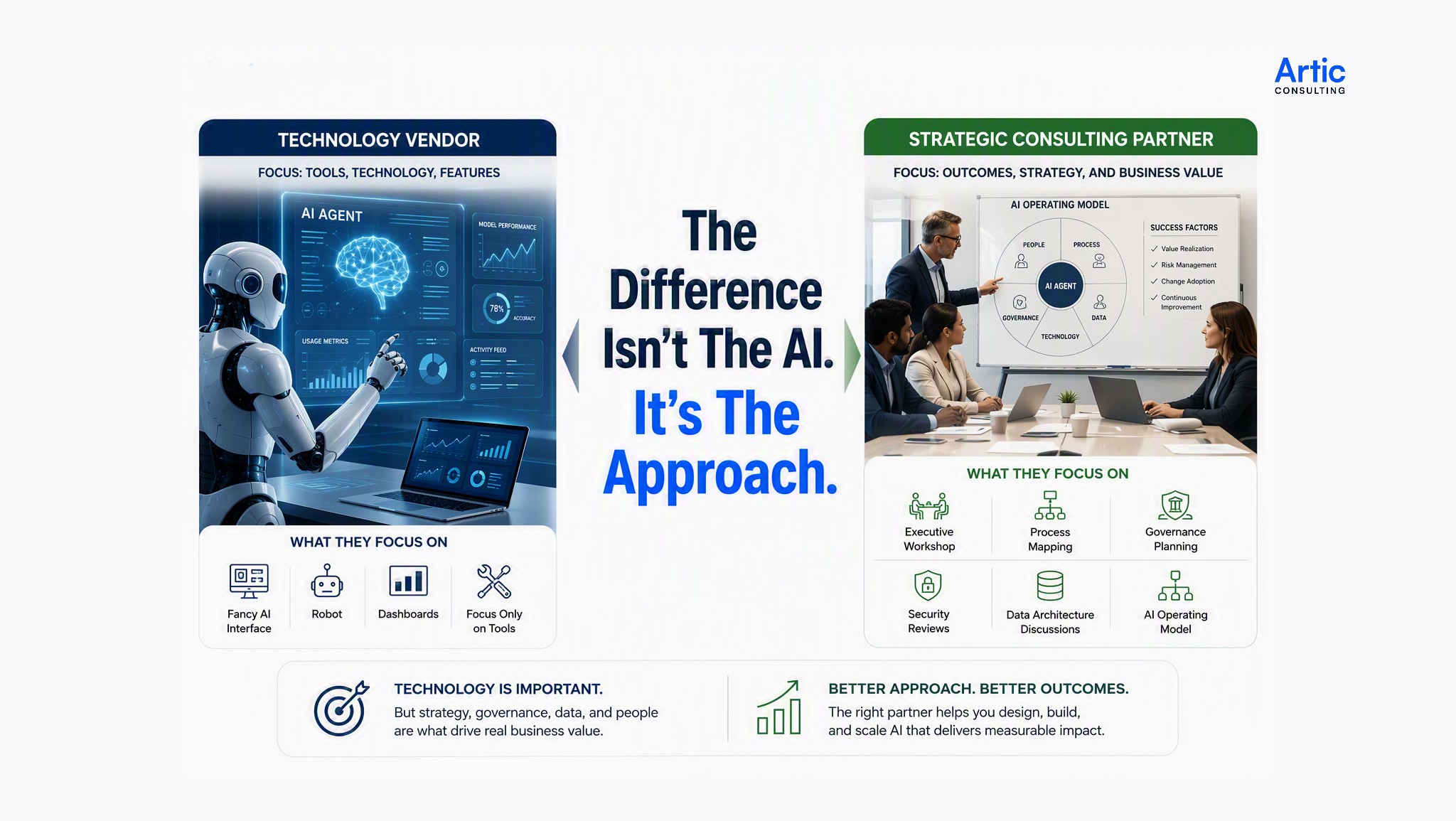
It also helps explain why implementation partners play a bigger role than they might in traditional AI projects. The conversation quickly moves beyond models and technology into areas like process design, governance, ownership, and change management.
The Quiet Reasons Agentic AI Projects Struggle
Every organization is different, but some patterns show up more often than others.
Observation #1: Teams Talk About The Agent Before They Talk About The Process
We’ve seen teams spend a lot of time discussing the agent and far less time discussing the process behind it.
Once the process is mapped out, there are usually more moving parts than expected. Approvals, exceptions, and workarounds have a way of showing up once people start looking more closely.
Observation #2: The Conversation Eventually Becomes About Data
We’ve seen projects start with AI and end up spending weeks on data.
Information lives in different systems. Teams use different sources. Important context sits inside documents, emails, and spreadsheets. The agent isn’t usually the problem. Finding the right information often is.
Observation #3: Pilots Can Create A False Sense Of Confidence
A pilot is usually small, controlled, and closely monitored. Production environments are not.
More users, more systems, and more exceptions can quickly change the complexity of the project.
Observation #4: Governance Doesn’t Feel Urgent Until It Does
Many teams focus on proving the idea first. Then questions start appearing.
Who approves decisions? What actions should require human involvement? How much autonomy is too much? Those conversations usually arrive later than expected.
Observation #5: Ownership Gets Complicated
One question tends to come up sooner or later:
Who owns the agent once it’s live?
Sometimes the answer isn’t as obvious as people expect, especially when multiple teams are involved.
Successful AI agent implementation often depends on governance, process maturity, and ownership.
Interestingly, those are rarely technology problems. They’re usually the areas where the right consulting partner adds the most value.
Why Most Agentic AI Projects Need More Than Just AI Expertise
One thing we’ve seen repeatedly is that agentic AI projects stop being AI projects fairly quickly.
The initial discussions might be about agents, models, and use cases. A few weeks later, the conversations usually involve a much larger group of people.
- Business teams explaining how the process actually works.
- IT teams connecting systems and data sources.
- Security teams reviewing access and controls.
- Compliance teams asking the hard questions.
- Operations teams thinking about what happens after go-live.
That’s usually where the conversation starts changing.
What began as an AI discussion suddenly involves business teams, IT, security, compliance, and operations.
Everyone is looking at the same initiative, but from a different angle.
We’ve seen projects move faster when those conversations happen early. We’ve also seen projects slow down when teams discover halfway through that they were working toward different expectations.
The agent may sit at the center of the project, but it’s rarely the only thing that determines how things unfold.
That’s also why organizations often need more than technical expertise. Bringing business, IT, security, compliance, and operations together is where the right consulting partner can make a meaningful difference.
The Governance Gap
Governance is one of those topics that rarely gets much attention in the early stages of an agentic AI project.
Most teams start by discussing possibilities. What could the agent do? How much time could it save? Which process should it support?
Then the project starts becoming real.
That’s usually when different questions begin to surface.
- Should the agent be allowed to take this action on its own?
- Does someone need to review or approve it?
- How would we know if something went wrong?
- Who is responsible for the outcome?
We’ve seen these questions come up regardless of industry or use case.
At that point, the conversation is no longer about what the agent can do. It’s about what the organization is comfortable allowing the agent to do.
A simple way to think about governance is through four areas:
1. Ownership
Who owns the agent after it goes live?
Not the technology itself, but the business process and outcomes connected to it.
2. Authority
What is the agent allowed to do without involving a person?
Some actions may be low risk. Others may need approvals or additional checks.
3. Oversight
When should a human step in?
Every organization has a different comfort level when it comes to autonomy. The important thing is deciding where those boundaries exist.
4. Accountability
If someone asks why a decision was made six months from now, can you explain what happened?
The more agents become part of everyday operations, the more important visibility and traceability become.
None of this is unique to agentic AI. Organizations have always needed ownership, accountability, and controls. Agentic AI simply forces those conversations to happen earlier and more explicitly than they might have otherwise.
We’ve found that this is often where organizations start evaluating their consulting partners differently. The discussion is no longer just about building an agent. It’s about helping the business establish the governance, ownership, and operating model needed to support it.
Explore how we helped fortune 500 client building an Enterprise AI Governance Framework.
The Microsoft Ecosystem Reality
Another thing we’ve noticed is that agentic AI projects rarely stay focused on a single tool for very long.
The conversation might start with Copilot Studio. Or Microsoft 365 Copilot. Or Azure AI.
A few meetings later, people are talking about data.
Then somebody asks where that data lives.
Then the discussion moves to workflows, integrations, security permissions, governance, and how the agent will interact with the rest of the business.
At that point, the question is no longer “Which AI tool should we use?”
It’s usually something closer to “How does all of this fit together?”
That’s where organizations start realizing that agentic AI is often connected to a much broader set of technologies:
- Microsoft 365 Copilot
- Copilot Studio
- Azure AI Foundry
- Microsoft Fabric
- Power Automate
- Dynamics 365
That’s usually when the focus shifts.
The discussion moves from AI capabilities to data, workflows, integrations, security permissions, and business processes.
The agent is still part of the conversation. It’s just no longer the entire conversation. This is also where the role of an agentic AI consulting partner tends to become more important. Evaluating individual tools is one thing. Connecting data, workflows, governance, security, and business processes into a solution that works in practice is something else entirely.
Useful read: Microsoft Licensing Costs Guide.
What Enterprise Leaders Should Look For in an Agentic AI Consulting Partner
Another thing we’ve learned is that organizations rarely struggle because they picked the wrong AI tool.
The harder challenges usually involve process, data, governance, and ownership.
When evaluating a partner, a few things tend to matter most.
They Ask Better Questions
The best conversations often happen before a solution is designed. A good partner will spend time understanding the process, challenging assumptions, and identifying issues that could become problems later.
They Look Beyond The Technology
Agentic AI projects are rarely just about models and tools. Process design, governance, ownership, and adoption often have just as much influence on the outcome.
They Understand The Bigger Picture
Agents don’t operate in isolation. Data platforms, business applications, workflows, security controls, and governance models eventually become part of the discussion.
They Think Beyond Go-Live
Launching an agent is only one milestone. Ownership, monitoring, adoption, and continuous improvement become just as important once the solution is in production.
At the end of the day, most organizations aren’t looking for someone to simply build an agent. They’re looking for a partner who can help navigate everything that comes with it.
Conclusion
A lot of the conversation around agentic AI starts with what the technology can do. What we’ve found is that the more important conversations usually happen around everything else- the process behind the work, the quality of the data, ownership, governance, etc. The different teams that need to work together once the agent moves beyond a pilot.
That’s often where the difference starts to emerge.
Organizations seeing the most value from agentic AI aren’t necessarily using more advanced technology. They’re spending time on the less visible work that makes long-term success possible.
At Artic Consulting, these are the conversations we find ourselves having most often. Not just how to build an agent, but how to make sure the people, processes, data, and technology around it are ready to support it.
Because in the end, creating business value is usually much harder and much more important than simply deploying another AI tool.
Planning an Agentic AI initiative?
Let’s evaluate your governance, data readiness, and AI strategy before you invest in another tool.
FAQs
1. Is agentic AI just another name for AI automation?
Not really. Automation usually follows a predefined path. Agents are expected to adapt as they work through a task, which is why conversations around governance and oversight tend to appear much earlier.
2. Why do so many agentic AI projects get stuck after the pilot stage?
The pilot often isn’t the difficult part. Things tend to get more complicated when more users, more systems, more data sources, and more exceptions enter the picture.
3. Do you need Microsoft Copilot Studio to build AI agents?
Not always. It depends on the use case, the systems involved, and the level of customization required. We’ve seen organizations use a combination of Microsoft 365 Copilot, Copilot Studio, Power Platform, Fabric, and Azure AI services.
4. Should AI agents replace people?
The conversations we’re seeing are usually about reducing repetitive work, not removing people from the process altogether.
5. How much governance is too much governance?
Most organizations don’t struggle because they have too many controls. They struggle because they introduce controls after the agent is already being designed or tested.
6. Is agentic AI mainly for large enterprises?
Large enterprises may have more opportunities, but many of the practical use cases we’re seeing involve common operational challenges that exist in organizations of all sizes.
7. What’s the biggest mistake companies make when evaluating agentic AI?
Focusing on the agent before understanding the process, the data, and the teams involved in making the process work.
8. What usually changes once an agent goes live?
The conversation. For instance, questions that seemed theoretical during planning suddenly become operational. Ownership, monitoring, approvals, and exceptions become much more real once the agent is part of day-to-day work.
9. How do you know whether an AI agent is actually successful?
A successful agent usually disappears into the process. People spend less time on repetitive work, decisions move faster, and the business achieves the outcome it was trying to improve.
Get started
Ready to level-up your business?

Amit Giri has 14 years of experience helping organizations navigate technology decisions and align solutions with business goals. His interests include artificial intelligence, Microsoft technologies, cloud solutions, data analytics, digital transformation, and process improvement. Through Artic Insights, Amit shares practical perspectives on using technology to solve real-world business challenges and create lasting value.