
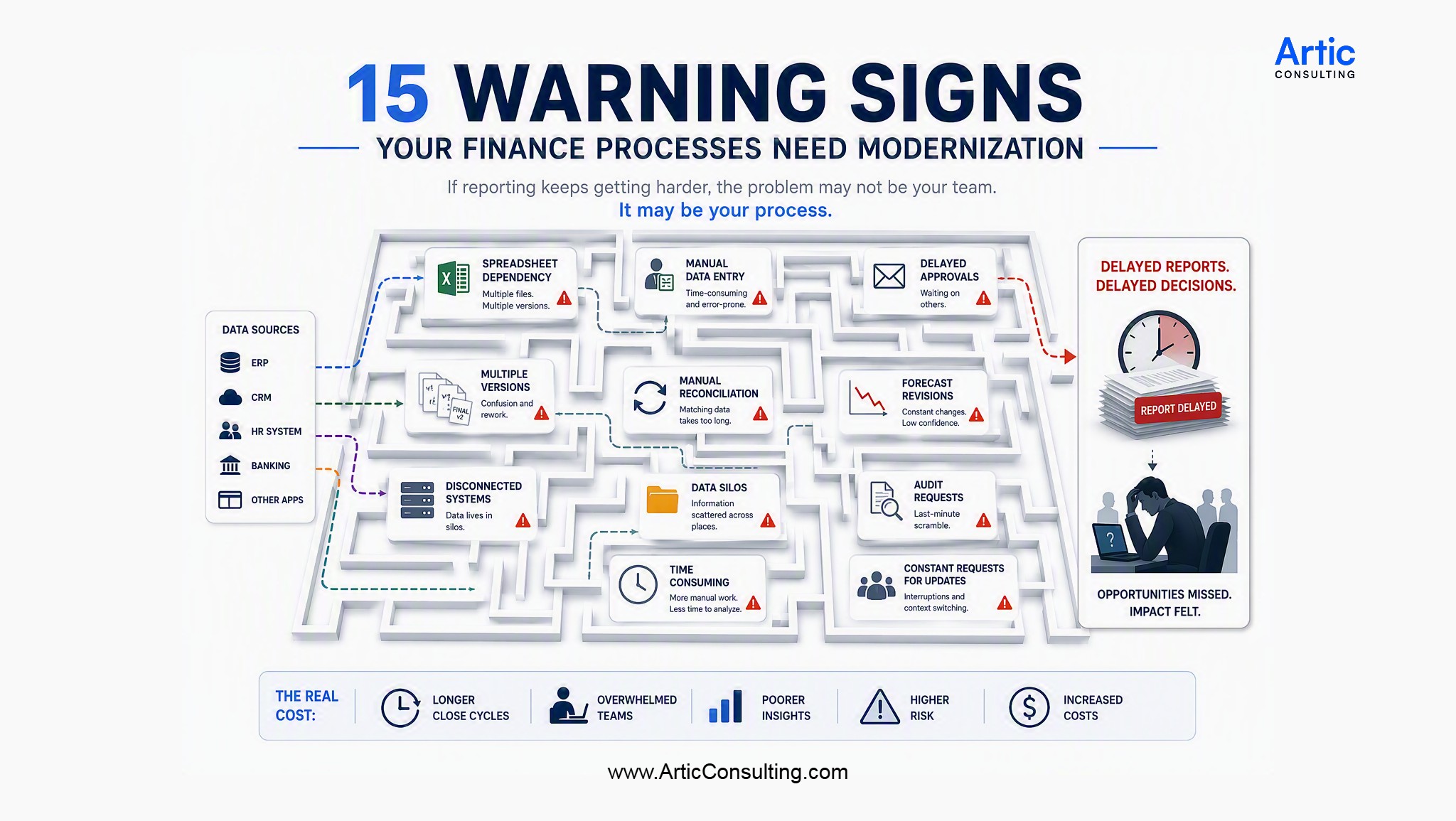
There is a reason finance teams joke about month-end. Everyone knows it’s coming. Everyone knows it will be busy. And somehow there are always reports to fix, numbers to check, files to update, and people waiting for answers.
For many businesses, that’s just become part of the routine.
The thing is, finance work shouldn’t feel harder every year. If reporting takes longer than it used to, if spreadsheets keep multiplying, or if getting a simple answer requires pulling data from three different places, those aren’t just everyday finance problems. They’re often signs that the processes behind the work have not kept up with the business.
Most companies don’t notice it happening. The extra steps get added one at a time. The workarounds stay in place. People adapt.
Then one day, a job that should take an hour takes half the day.
That’s usually when questions about modernization start coming up.
In this article, we’ll look at 15 warning signs that your finance processes may be making work harder than it needs to be.
1. Month-End Close Takes Longer Than it Used To
Month-end close starts on Monday. By Thursday, people are still chasing missing information, checking figures, and waiting for updates from other teams. Finance cannot move forward until everything lines up.
The frustrating part is that nobody can point to one big issue. It’s usually a mix of small delays. Data comes in late. Numbers need another review. Something doesn’t match and has to be checked again. One extra day becomes two or three.
If closing the books seems to take longer now than it did a few years ago, it’s worth asking why.
Warning signs:
- Close timelines keep increasing
- Teams work overtime during month-end
- Reports are delivered later than expected
- Data collection takes longer each cycle
2. Reporting Depends on Too Many Spreadsheets
Most finance teams use spreadsheets. That’s not the problem. The problem is when reporting cannot happen without them.
A file gets downloaded from one system. Another file comes from somewhere else. Someone copies data into a master spreadsheet. Then another person updates formulas, checks totals, and shares a new version with the team.
It works. Until someone updates the wrong file, uses an old version, or notices that two reports show different numbers.
When spreadsheets become the main way data moves through finance, reporting often takes more effort than it should. Teams spend time maintaining files instead of reviewing results and understanding what the numbers are saying. Spreadsheet dependency and manual workarounds are commonly cited warning signs that finance processes have outgrown their existing systems.
Warning signs:
- Multiple spreadsheet versions
- Manual copy-and-paste work
- Formula errors appear regularly
- Teams rely on email attachments
- Reports require spreadsheet consolidation before sharing
3. Teams Keep Double-Checking the Numbers
A report gets shared. A few minutes later someone asks, “Can we verify these numbers?”
Then another version gets sent.
Then someone notices a difference between two reports.
Finance teams expect to review their work. That’s normal. The concern is when the same numbers need to be checked again and again before anyone feels comfortable using them.
Over time, people start keeping their own spreadsheets, running their own calculations, or asking for extra validation before making decisions. Meetings that should focus on performance end up focusing on whether the numbers are correct.
When confidence in the data starts slipping, finance work becomes slower for everyone. Teams spend more time proving the numbers are right instead of discussing what the numbers mean. Questions about data accuracy and report reliability are common signs that finance processes need attention.
Warning signs:
- Reports need repeated validation
- Different reports show different figures
- Teams maintain their own calculations
- Meetings focus on data accuracy
- People ask for additional verification before using reports
4. Financial Data is Scattered Across Different Systems
Finance needs information from everywhere. For instance, sales data sits in one system, expenses are tracked somewhere else, and project information lives in another application. Before reporting can even begin, someone has to pull everything together. This challenge is commonly associated with fragmented systems and disconnected finance data.
Most teams get used to the process. Download a file. Export another report. Copy the data into a spreadsheet. Check that everything matches.
Nobody notices the extra steps at first. One report comes from one system, another report comes from somewhere else, and someone pulls everything together. After a while, a simple report can involve a lot more work than anyone realizes.
Fragmented systems are cited as a common sign that finance processes may need modernization.
Warning signs:
- Data exists in multiple applications
- Reports require several exports
- Teams manually combine information
- Reconciliation takes significant time
- No single view of financial data exists
5. Forecasts Feel More Like Estimates Than Plans
A forecast gets shared at the start of the month. A few days later, a new version goes out.
Then another one follows because a project was delayed, sales numbers changed, or a cost was higher than expected.
Before long, people are opening different versions of the same file to see what changed. Some teams even keep older copies because they know another update is probably coming.
When forecasts are revised so often that people stop relying on them, it becomes harder to use them for planning.
Warning signs:
- Forecasts change frequently
- Teams use different assumptions
- Actual results regularly miss forecasts
- Scenario planning takes too long
- Leadership lacks confidence in projections
6. Leadership Keeps Asking for Updated Numbers
Revenue in one report is different from revenue in another. The finance team pulls both reports and starts comparing them line by line. One number came from an export completed last week. Another came from a spreadsheet that was updated yesterday.
Finding the difference can take longer than creating the report itself. The problem is not always a calculation error. Sometimes the same information is being. pulled from different systems, updated at different times, or stored in different files. Over time, it becomes harder to keep everything aligned.
Warning signs:
- Frequent requests for updated reports
- Multiple versions of the same report
- Last-minute report changes
- Teams spend time explaining differences
- Leaders wait for current financial information
7. Manual Work is Taking Up Too Much Time
Many finance activities still involve downloading files, updating spreadsheets, moving data between systems, and preparing reports by hand. Manual data entry and repetitive reporting tasks are commonly identified as signs that finance processes need improvement.
Accenture’s State of FP&A Pulse Survey found that FP&A teams spend up to 85% of their time on production-focused activities such as reporting, data collection, and reconciliation, leaving only 15% for future-focused analysis.
What starts as a few manual steps can gradually become part of the reporting process. Teams follow the same tasks every week or every month because that’s how the work gets done.
As reporting volumes increase, those extra steps take up more time and require more effort to maintain. Finance transformation initiatives often focus on reducing repetitive manual activities through process improvements and automation.
Warning signs:
- Frequent manual data entry
- Repetitive spreadsheet updates
- Heavy reliance on copy-and-paste
- Reports require significant preparation
- Routine tasks consume most of the day
8. Finance is Constantly Waiting for Information
Reporting cannot move forward if the information needed to complete it has not arrived. Missing timesheets, delayed approvals, incomplete project updates, and late submissions can slow reporting long before finance starts its work. What appears to be a reporting issue is often an information issue.
Finance teams end up spending valuable time following up on missing data instead of analyzing results. Delayed inputs and incomplete information are common contributors to longer reporting cycles.
As these delays become more frequent, reporting schedules become harder to maintain and month-end pressure increases across the team.
Warning signs:
- Missing timesheets or project updates
- Delayed approvals
- Incomplete data submissions
- Frequent follow-ups for information
- Reporting deadlines are regularly missed
9. Reporting Tells You What Happened, Not What’s Coming Next
Most finance teams can tell you what happened last month. Revenue, expenses, margins, and cash flow are all available in the reports. The challenge starts when people need answers about what comes next.
Forecasting takes time. Scenario planning requires manual work. Teams spend so much time preparing reports that there is little time left to look ahead. Limited forecasting capabilities and a heavy focus on historical reporting are commonly associated with finance functions that need modernization.
Historical reporting is important, but finance teams also need visibility into future performance. Without that capability, planning becomes more difficult as the business grows and changes.
Warning signs:
- Most reporting focuses on past performance
- Forecasting is slow and manual
- Scenario planning takes significant effort
- Future projections are difficult to produce
- Teams spend more time reporting than planning
10. Audit Requests Create Last-Minute Work
Audit requests are a normal part of finance operations. The challenge starts when finding the required information takes longer than expected. Documents sit in different folders, supporting records need to be tracked down, and teams spend days gathering information that should be easy to access.
As the business grows, the amount of information involved also grows. What once took a few hours can turn into a much larger effort, especially if records are spread across multiple systems or managed through manual processes. Compliance activities that require significant manual effort are commonly associated with finance processes that need improvement.
Warning signs:
- Documents are stored in multiple locations
- Teams spend significant time gathering audit evidence
- Supporting records are difficult to find
- Audit preparation requires manual effort
- Compliance requests disrupt normal work routines
11. Extra Workarounds Have Become Part of the Process
Most workarounds start as temporary fixes. A spreadsheet is created to track missing information. An extra approval step is added. Teams build their own reports because the existing ones do not give them what they need.
Over time, those temporary fixes become part of the process. More steps are added, more files are created, and more effort is needed to complete routine finance tasks. Process workarounds are commonly seen as an early sign that existing systems and processes are no longer meeting business needs.
Forbes Business Council contributors highlight process workarounds, operational friction, and growing dependency on manual processes as early warning signs that organizations may be heading toward larger operational challenges.
Many organizations continue working this way for years because the process still functions. The challenge is that every workaround adds complexity and increases the amount of work required to maintain reporting and finance operations.
Warning signs:
- Teams rely on unofficial spreadsheets
- Extra manual steps have been added over time
- Different departments follow different processes
- Employees create their own tracking methods
- Temporary fixes have become permanent routines
12. Growth Creates More Finance Work
Business growth naturally brings more transactions, more reports, and more data to manage. The real challenge starts when every increase in activity creates even more manual work for the finance team. Tasks that were manageable a few years ago take longer to complete, reporting cycles become harder to maintain, and additional resources are needed just to keep up with existing processes. Growth-related scalability challenges are commonly identified as signs that finance operations may need modernization.
Finance processes should be able to support business growth without requiring a proportional increase in effort. If growth consistently creates reporting bottlenecks or operational complexity, existing processes may no longer be meeting the needs of the business.
Warning signs:
- Reporting takes longer as the business grows
- Finance workload increases significantly each year
- Additional headcount is needed to manage routine tasks
- New entities, locations, or business units create reporting challenges
- Existing processes struggle to handle higher transaction volumes
13. You Still Have to Wait for Reports
Finance teams need timely information to support planning, reporting, and day-to-day decisions.
The problem is that many reports are only available after data has been collected, reviewed, reconciled, and prepared. By the time the report is ready, the information may already be several days old. Delayed reporting and limited access to current financial information are common signs that finance processes are struggling to keep pace with business needs.
Many organizations continue to rely on reporting cycles that require significant preparation before information can be shared. As reporting demands increase, those delays often become more noticeable across the business.
Warning signs:
- Reports are only available at specific times
- Financial updates take days to prepare
- Teams wait for information before taking action
- Reporting relies on manual preparation
- Current financial performance is difficult to view quickly
14. Most of the Reporting Cycle is Spent Preparing Data
Getting the numbers ready often takes longer than reviewing the results. Data is collected from different sources, checked for accuracy, matched across reports, and prepared for reporting. By the time everything is ready, a significant amount of effort has already gone into preparation.
Many finance teams spend a large portion of their reporting cycle gathering information, validating data, and resolving differences before reports can be shared. Time spent on reporting preparation instead of analysis is a common challenge in finance operations.
As reporting requirements increase, the amount of preparation work often increases as well. Teams continue adding checks, validations, and manual review steps to keep reporting on track.
Warning signs:
- Significant time spent collecting data
- Extensive data validation before reporting
- Reconciliation delays report delivery
- Reporting preparation takes longer than analysis
- Teams spend more time preparing reports than reviewing results
15. Finance Has Become More Complex Than it Needs To Be
Finance processes tend to expand over time. New reports are added, additional approvals are introduced, and more systems become part of the reporting process. Each change may solve a specific problem, but the overall process becomes more difficult to manage.
As complexity increases, routine tasks often require more coordination, more reviews, and more manual effort. Activities that were once straightforward can take longer to complete because there are simply more steps involved. Process complexity is a common challenge for organizations that rely on disconnected systems, manual workflows, and growing reporting requirements.
Many organizations continue operating this way because the process still delivers results. The challenge is that complexity often grows faster than efficiency, creating additional work across finance operations.
Warning signs:
- Reporting involves multiple systems and handoffs
- Routine tasks require several approval steps
- Processes become harder to maintain each year
- New requirements add more manual work
- Finance operations take more effort than before
Real-World Example: Modernizing Finance Operations with Microsoft
Many organizations recognize the warning signs of outdated finance processes but struggle to determine where to start.
One leading U.S.-based Banking, Financial Services, and Insurance (BFSI) organization faced challenges that will sound familiar to many finance leaders:
- Legacy systems
- Disconnected data sources
- Limited visibility into performance
- Increasing pressure to improve operational efficiency
To address these challenges, the organization partnered with Artic Consulting to implement a Microsoft-powered modernization strategy that included Azure, Power BI, Dynamics 365, and AI-driven capabilities. The transformation helped centralize data, improve reporting and analytics, strengthen fraud detection, and enhance customer experiences.
Results Achieved
- 50%+ improvement in operational efficiency through automation of manual workflows and reporting activities.
- 40% reduction in fraudulent transactions using Azure Security and AI-powered fraud detection.
- 25% improvement in customer satisfaction through personalized services and data-driven insights.
The lesson is simple: finance modernization is not just about technology. It’s about reducing manual effort, improving visibility, accelerating decision-making, and creating a foundation that can scale as the business grows.
Read the full case study: How a Leading BFSI Firm Transformed with Microsoft Financial Solutions
You Don’t Need All 15 Signs to Have a Problem
Most organizations will not see every issue on this list. However, if several of these warning signs sound familiar, it may be worth taking a closer look at how finance work gets done across the business.
Slow reporting cycles, spreadsheet dependency, manual processes, reporting delays, and disconnected systems often develop gradually. Because the process still works, these challenges can remain in place for years before they receive attention.
Finance modernization is not about replacing existing processes overnight. It is about identifying where time is being lost, where manual effort is increasing, and where better workflows can help teams work more efficiently.
Wondering Where Your Finance Processes Stand?
Many finance teams know something feels inefficient but struggle to identify where the biggest bottlenecks exist.
Artic Consulting helps organizations assess finance operations, reporting workflows, and process dependencies to uncover opportunities for improvement.
FAQs
1. How do I know if our reporting process has become too complex?
A simple sign is the amount of effort required to produce reports. If teams spend days collecting data, checking spreadsheets, and validating numbers before every reporting cycle, complexity has likely become a problem.
2. Do we need to move everything into one reporting tool?
Not necessarily. Plenty of companies run reporting across several systems. The issue usually starts when people are exporting data from one tool, moving it into another, and fixing things manually every month.
3. Why do people keep arguing about which number is correct?
That usually happens when reports are being built from different sources. One team pulls data from the ERP, another from a spreadsheet, and suddenly everyone is explaining numbers instead of discussing the business.
4. Will automation fix our reporting problems?
Only if the process makes sense in the first place. If teams are spending hours correcting data before reports go out, automation may simply help the mistakes happen faster.
5. Why does reporting still take so long at month-end?
For many finance teams, the reporting itself isn’t the slow part. The time often goes into chasing missing data, checking formulas, and making sure everyone is working from the same figures.
6. We deliver reports on time. Does that mean the process is working?
Not always. Some teams hit reporting deadlines every month, but only because people are putting in extra hours behind the scenes. A process can appear smooth while relying heavily on manual effort.
7. What’s the first thing to review when reporting becomes difficult?
Look at where people spend their time. If most of the effort goes into collecting, combining, and checking data, that’s usually where the biggest improvement opportunities are hiding.
8. Do more dashboards help?
Sometimes. Sometimes they create another place for people to look. If teams already struggle to agree on the numbers, adding more dashboards rarely solves the underlying problem.
9. Why do executives lose confidence in reports?
It often starts after they’ve seen different versions of the same metric. Once leaders begin asking which report is correct, trust becomes harder to rebuild.
10. How can we tell if our reporting process needs attention?
A simple test is to ask the team what happens if one or two key people are unavailable. If reporting slows down significantly because critical knowledge sits with a few individuals, it’s probably worth taking a closer look.
Table of contents
- Overview
- Signs Your Finance Processes Need Modernization
- Month-End Close Takes Longer
- Reporting Depends on Too Many Spreadsheets
- Teams Keep Double-Checking the Numbers
- Data is Scattered Across Systems
- Forecasts Feel More Like Estimates Than Plans
- Leadership Keeps Asking for Updated Numbers
- Manual Work is Taking Up Too Much Time
- Finance is Constantly Waiting for Information
- Reporting Tells You What Happened, Not What’s Coming Next
- Audit Requests Create Last-Minute Work
- Extra Workarounds Have Become Part of the Process
- Growth Creates More Finance Work
- You Still Have to Wait for Reports
- Most of the Reporting Cycle is Spent Preparing Data
- Finance Has Become More Complex Than it Needs To Be
- Real World Example
- You Don’t Need All 15 Signs to Have a Problem
- FAQs
Get started
Ready to level-up your business?

Amit Giri has 14 years of experience helping organizations navigate technology decisions and align solutions with business goals. His interests include artificial intelligence, Microsoft technologies, cloud solutions, data analytics, digital transformation, and process improvement. Through Artic Insights, Amit shares practical perspectives on using technology to solve real-world business challenges and create lasting value.